Daily Tech Briefing
AI 科技速览
每天 5 分钟内学习 AI。获取最新的人工智能新闻,理解其重要性,并学习如何将其应用于您的工作。
Latent Space · 2026/8/4 18:20:14
Unpacking ChatGPT Work: the Agent for a Billion Users
AI 中文解读
ChatGPT Work来了!OpenAI这次直接把AI从聊天框里带进了职场,让它帮你干“正经活”。简单说,这就是个能独立工作的“AI数字员工”:你把它连上Slack、邮箱、日历这些日常工具,它就能自己翻资料、整理信息,直接给你产出成稿的文档或表格,不用你一步步指挥。
这产品上线三周就吸引了1000万用户,而整个ChatGPT的周活跃用户已经逼近10亿。更关键的是,它将来会直接并入ChatGPT的主界面,意味着这一技术不只是少数效率爱好者的玩具,而是所有普通用户都能上手的日常能力。
对普通人来说,最直接的变化就是那些烦人的重复劳动——整理会议纪要、汇总邮件、填报表——可以甩给AI了。你不用懂技术,只要会点鼠标,它就在云端电脑里自动干活,你关掉电脑它也能继续处理。AI工作者可能真的要变成你的“同事”了。
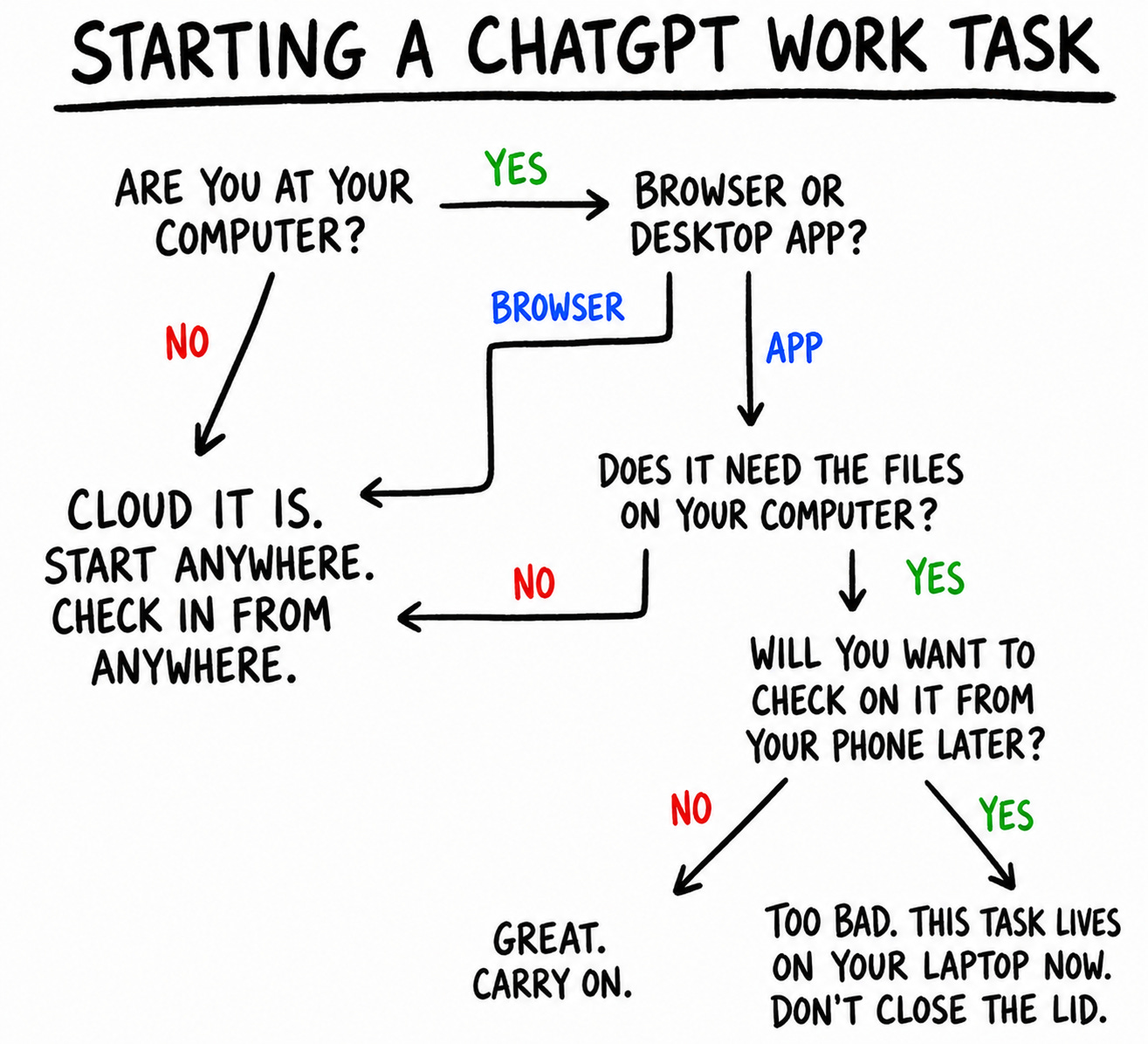
Editor’s note: I’m excited to welcome Shlok to our guest post roster! You may know Shlok from his excellent explorations (as an outsider — for an insider perspective see our podcast with OpenAI’s Akshay Nathan. Already one of our most popular episodes of the year!) of leading AI Lab memory systems, which he gave an excellent AIE talk on. We’ve been covering OpenAI’s research and deployment of agents to all of humanity since Plugins 2023 and Devday 2024 and Codex 2025, and now ChatGPT Work in 2026 seems the penultimate stage of the long journey. Let’s dive in!On July 9th, OpenAI released ChatGPT Work, their agent product for knowledge work. It was, by any measure, a busy launch: three new models across fourteen configurations, a consolidation of the ChatGPT and Codex desktop apps, and cloud agents brought to the mainstream in their most accessible form yet.Three weeks in, Work (along with Codex) has reportedly crossed 10 million users.Editor’s note: ChatGPT estimated to cross 1B MAU in June and 1B WAU this month.Chat and Work currently sit side by side as separate modes inside ChatGPT, but Greg Brockman has confirmed that they will merge by the end of the year. Work, then, is not just a niche product for power users, but a preview of how ChatGPT’s billion weekly users will soon use the app. That’s why people inside and outside OpenAI are so excited about it, and why it deserves a closer look.Work in its current form takes some decoding. It’s an amalgamation of ChatGPT (in chat form), Codex the app, Codex the harness, Codex the original cloud agent, ChatGPT agent, Atlas, OpenClaw, and more. The product lineup around it is confusing. And the web and mobile versions diverge from the desktop one (unless you run it in cloud mode?!).So I spent the past few days trying to unpack it: what Work is, where it fits in OpenAI’s lineup, the many interesting choices in its design, the tensions underneath, and where I think it’s headed. Most of what follows comes from Codex and me poking around inside Work, and I’ve linked those conversations throughout so you can see where each claim comes from.What is Work?At its core:An agent for knowledge work. You connect it to the places you already work—Slack, email, Drive, calendars, CRMs, project trackers, and hundreds of other plugins—and it gathers context across all of them to produce finished work.Runs on the Codex harness. So it inherits the same models, sub-agents, browser use, and the ability to grind on a task for hours. Its UI is stripped of the evidence (git controls, diff-traces) that would give away you’re talking to a coding agent.Lives in a cloud computer. Specifically, a beefy, isolated microVM: Pro accounts get 8 CPUs, 20GB of RAM, and a 64GB disk; Plus gets 14GB of RAM. Alongside the VM, Work gets a managed Chrome service that the agent operates through tool calls.Produces artifacts. Sheets, docs, and slides rendered in interactive viewers, plus Sites: hosted web apps and dashboards it can build, share via URL, and keep updated.Every new conversation in Work is called a task. On web and mobile, Work runs in the cloud. You can kick off a task on web, track progress and give directions in the ChatGPT app on your phone, then view the result (maybe a report or a spreadsheet) back on your laptop.Work on the desktop app is slightly different and comes in two modes: cloud and local. In cloud mode, tasks run on the same cloud computer as web and mobile and sync across all three.In local mode, the agent works directly on your machine, across your files and apps, with full computer use. These tasks don’t appear on web or mobile, and there’s no way yet to move a local task to the cloud. This makes local mode essentially Codex, minus the code-related UI traces that would scare off a non-developer.On desktop, each new Work task can run locally on your computer or in the cloud.But then
分享
阅读原文 ↗