Daily Tech Briefing
AI 科技速览
每天 5 分钟内学习 AI。获取最新的人工智能新闻,理解其重要性,并学习如何将其应用于您的工作。
AWS ML Blog · 2026/8/3 16:30:58
Automated Reasoning policy refinement in Amazon Bedrock
AI 中文解读
亚马逊云服务又整新活了!这次发布的是一个让AI“守规矩”更省事的新工具,核心亮点就是:AI安全策略的调整从完全靠人工苦力,变成了机器自动“看病开方”,开发者只需点一下批准就行,准确率还号称最高99%。
这技术到底是个啥?说白了,生成式AI有时候会一本正经地胡说八道,所以亚马逊给AI装了个“安全护栏”来验证回答对不对。以前这个“护栏”的规则太严或太松,程序员就得一遍遍手动修改测试,特别费劲。现在新工具能自动诊断哪条规矩坏了,直接给出修复方案,就像文档里的拼写错误自动标红并给出修改建议一样,你确认就改好了。
对普通人来说,这事看起来是给程序员减负,但最终受益的是你我。以后用AI客服办业务或AI医生看报告时,因为安全规则能被更高效地调试更新,AI说错话的概率就会更低,回复也会更靠谱,你问出来的答案可信度就更高了。
<p>Refining an Automated Reasoning policy in Amazon Bedrock has been a manual cycle of diagnose, hand-edit, retest, and repeat. Today, we are announcing automatic policy refinement, which automates the diagnose-and-fix work in that cycle. The refinement engine diagnoses failing tests and proposes formal-logic fixes. You approve every change before it takes effect.</p>
<p><a href="https://docs.aws.amazon.com/bedrock/latest/userguide/guardrails-automated-reasoning-checks.html" target="_blank" rel="noopener">Automated Reasoning checks</a> in Amazon Bedrock Guardrails use formal verification to prove answer correctness. On unambiguous translations from natural language to formal logic, they deliver up to 99% verification accuracy, as reported in the <a href="https://aws.amazon.com/blogs/aws/minimize-ai-hallucinations-and-deliver-up-to-99-verification-accuracy-with-automated-reasoning-checks-now-available/" target="_blank" rel="noopener">GA announcement</a>. To get started, you build an Automated Reasoning policy from a source document and validate it with test cases. Customers told us that this iterative tuning creates the biggest friction point in policy development.</p>
<p>In this post, we walk through two new refinement modes: <strong>Iterative Refinement</strong> for rule issues, and <strong>Ambiguous Variable Refinement</strong> for language issues. For each mode, we show a complete API workflow (start, poll, retrieve) and a repeatable console workflow for turning failing policies into passing ones.</p>
<h2 id="what-automated-reasoning-checks-actually-are">What Automated Reasoning checks actually are</h2>
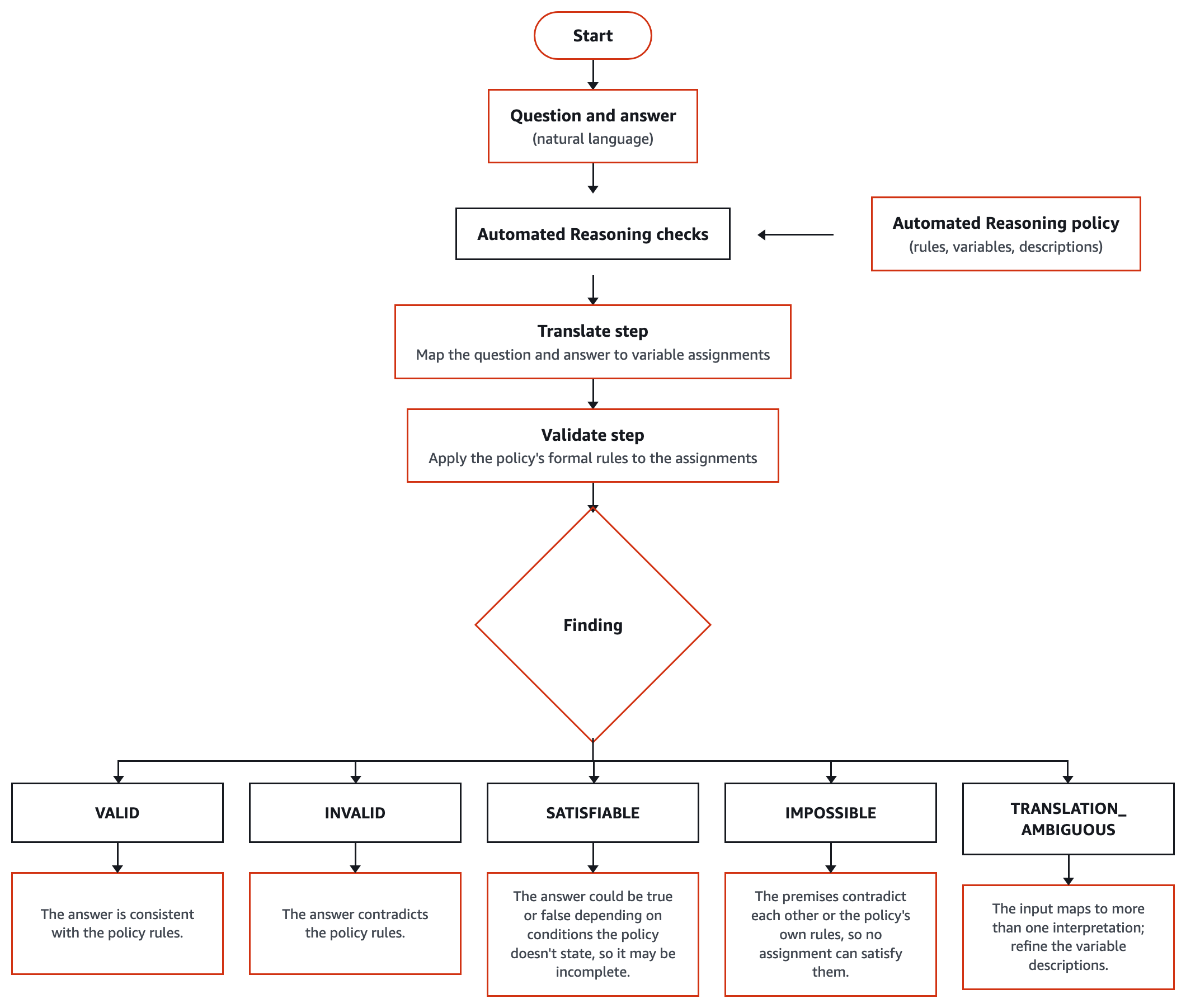
<p>Automated Reasoning checks translate natural language into formal logic, then apply automated reasoning techniques to produce a finding: <code>VALID</code>, <code>INVALID</code>, <code>SATISFIABLE</code>, <code>IMPOSSIBLE</code>, or <code>TRANSLATION_AMBIGUOUS</code>. For a full introduction to how policies work, refer to our <a href="https://aws.amazon.com/blogs/aws/minimize-ai-hallucinations-and-deliver-up-to-99-verification-accuracy-with-automated-reasoning-checks-now-available/" target="_blank" rel="noopener">GA announcement post</a>.</p>
<p>For this post, the key concept is the <strong>two-step validation pipeline</strong>. First, the <strong>translate</strong> step maps natural-language input/output to variable assignments using the variable descriptions in your policy. Second, the <strong>validate</strong> step applies your formal rules to those assignments. When a test fails, the root cause lives in one of those two steps, and each refinement mode targets a different one. Figure 1 traces that pipeline end to end.</p>
<div style="width: 810px" class="wp-caption alignnone">
<img src="https://d2908q01vomqb2.cloudfront.net/f1f836cb4ea6efb2a0b1b99f41ad8b103eff4b59/2026/07/27/ML-21259-1.png" alt="How Automated Reasoning checks validate a response at runtime" width="800" height="1802">
<p class="wp-caption-text">Figure 1: How Automated Reasoning checks validate a response at runtime. Automated Reasoning checks translate natural language into variables using the policy’s variable descriptions, then validate those variables against the policy’s formal rules to return a finding. This two-step pipeline is why refinement has two modes.</p>
</div>
<p><strong>Testing your policy.</strong> You validate a policy by attaching tests: each test is input/output text plus the result you expect. Run tests individually or as a batch. Failures tell you exactly where the policy diverges from your intent.</p>
<h2 id="why-policies-need-refinement-two-failure-modes">Why policies need refinement: Two failure modes</h2>
<p>Recall the two-step pipeline: <strong>translate</strong> (natural language to variable assignments) and then <strong>validate</strong> (formal logic to finding). A failed test means one of these steps produced something you didn’t expect. Automated Reasoning checks surface two distinct failure signals that map cle
分享
阅读原文 ↗