Daily Tech Briefing
AI 科技速览
每天 5 分钟内学习 AI。获取最新的人工智能新闻,理解其重要性,并学习如何将其应用于您的工作。
Nature Machine Intelligence · 2026/8/3 00:00:00
Beyond representational alignment with brain-guided language models for robust reasoning
AI 中文解读
这项研究发表在《自然·机器智能》上,核心突破在于:科学家首次发现,人类大脑在推理时发出的神经信号,可以直接用来提升AI大模型的推理能力,准确率最高提升13%。
通俗地说,此前AI与大脑的对比研究大多停留在“相似性”层面——发现AI内部活动模式与大脑有几分相像。但这篇论文更进一步,直接把脑扫描获得的信号“喂”给AI,当作指导AI思考的额外线索。研究人员让10个不同规模的大模型在处理逻辑推理题的同时,参考人类大脑负责推理区域的活跃模式,结果这些模型的表现明显变好,且这种提升不受语言训练数据的影响,说明脑信号提供了语言之外的全新信息。
这项成果的意义在于,它把AI与大脑从“长得像”推进到了“能指导”的阶段。未来,这类技术可能让AI在复杂决策、法律推理、医疗诊断等需要严谨思考的场景中更可靠,出错的概率更低。长远看,结合人类认知规律训练的AI,也会让普通用户在使用智能助手时感觉它“更懂人、更靠谱”,而不是机械地回答问题。
Article
Published: 03 August 2026
Beyond representational alignment with brain-guided language models for robust reasoning
Mingqing Xiao
(肖命清)
ORCID: orcid.org/0000-0001-6191-77261,2, Kai Du
(杜凯)
ORCID: orcid.org/0000-0002-7505-15613 & Zhouchen Lin
(林宙辰)
ORCID: orcid.org/0000-0003-1493-75691
Nature Machine Intelligence
(2026) Cite this article
Save article
View saved research
A preprint version of the article is available at arXiv.
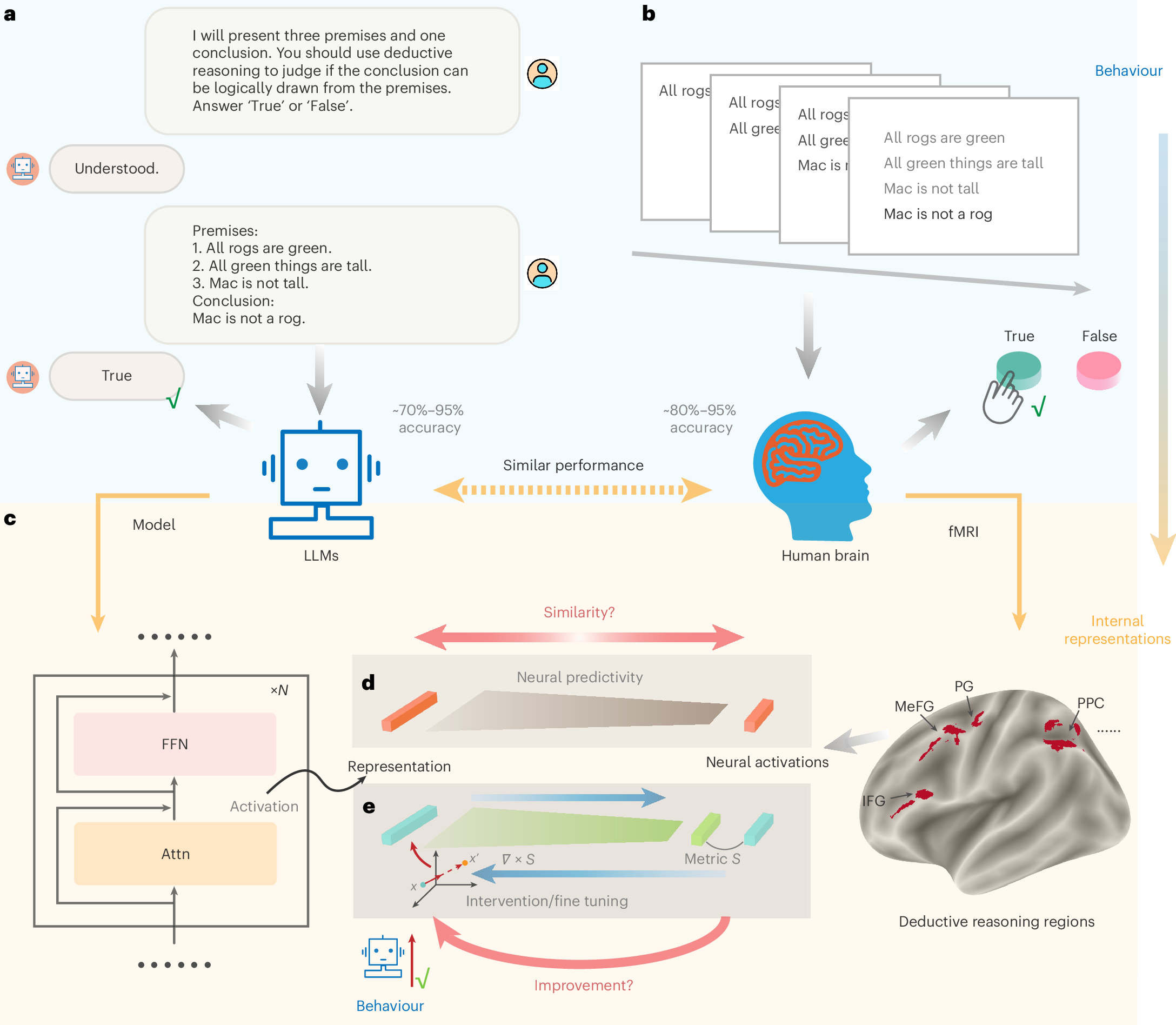
AbstractThe correspondence between large language models (LLMs) and the neural mechanisms underlying human higher-order cognition remains insufficiently characterized. Given that language and reasoning in the human brain appear dissociable, an open question is whether LLMs align with neural signals from reasoning-related regions and whether such signals can improve them. Here, focusing on deductive reasoning, we show that LLM internal representations are not only partially aligned with task-based functional magnetic resonance imaging activity but can also be directly enhanced by these signals. Using a neural predictivity metric, we find that LLMs explain a substantial fraction of the explainable variance in reasoning-related regions at the aggregate level, whereas predictivity within specific reasoning types is lower, indicating both alignment and divergence. Building on this, we propose a brain-guided framework: we steer model representations along directions induced by the joint structure of model and brain representations, applying intervention at inference and fine tuning during training. We demonstrate that task-evoked brain signals can directly enhance LLM reasoning, yielding gains orthogonal to language-only supervision across ten LLMs (1.5B–72B parameters), with transfer across reasoning types and up to 13% absolute accuracy gain. Our results advance LLM–brain correspondences from correlation to guidance, establishing a brain-signal-driven pathway towards more robust and cognitively aligned artificial intelligence.
This is a preview of subscription content, access via your institution
Access options
Access through your institution
/* style specs start */
/* style specs end */
Access Nature and 54 other Nature Portfolio journals
Get Nature+, our best-value online-access subscription
$32.99 / 30 days
cancel any time
Learn more
Subscribe to this journal
Receive 12 digital issues and online access to articles
$119.00 per year
only $9.92 per issue
Le
分享
阅读原文 ↗