Daily Tech Briefing
AI 科技速览
每天 5 分钟内学习 AI。获取最新的人工智能新闻,理解其重要性,并学习如何将其应用于您的工作。
Simon Willison · 2026/7/31 21:15:23
smevals - a small eval suite for evaluating models, prompts, and harnesses
AI 中文解读
smevals这个新工具最吸引人的地方在于,它把原本复杂的AI模型评测变得极其简单——你只需要告诉AI助手说“请帮我创建一个评测”,它就能自动生成一套测试题,然后一键对比不同AI模型的答题表现,相当于给AI们办了一场标准化考试。
用个通俗的比喻:以前你想知道哪个AI写诗更厉害,得一个个问过去,再手动打分。现在用smevals,你只要把测试要求写成一份简单的配置文件,告诉它“跑一下GPT和Claude”,它就会自动让所有候选AI完成同样的任务,然后按你设定的标准打分,最后生成一份带排行榜的可视化报告,甚至能放进网页里分享。
这项技术听起来很专业,但实际影响很实在。它让评测AI的门槛大幅降低,普通开发者甚至创业者都能快速判断哪款模型最适合自己的需求,不用再凭感觉或听广告。对我们普通用户来说,以后用到的AI产品会越来越靠谱,因为厂商在上线前能更高效地测试和优化模型,那些“一本正经胡说八道”的AI也会少很多。简单说,这是给AI行业装了个“质检仪”,让每一行代码背后的选择都更有依据。
<p><strong><a href="https://primeradiant.com/blog/2026/smevals.html">smevals - a small eval suite for evaluating models, prompts, and harnesses</a></strong></p>
I've been working with Jesse Vincent's <a href="https://primeradiant.com">Prime Radiant</a> applied AI research lab building out this evals framework to help answer questions about the capabilities of different models.</p>
<p>The result is <strong><a href="https://github.com/prime-radiant-inc/smevals">smevals</a></strong>, a new tool for running small eval suites across different model configurations and grading the results.</p>
<p>The <a href="https://primeradiant.com/blog/2026/smevals.html">blog entry</a> describes the tool in detail. Here's the 10 second version:</p>
<ol>
<li>Tell your coding agent to <code>run uvx smevals docs</code> to learn the tool (this outputs <a href="https://github.com/prime-radiant-inc/smevals/blob/main/README.md">the README</a>)</li>
<li>Then tell it to build you an eval suite</li>
</ol>
<p>Once you've created an eval - which takes the form of a directory with some YAML files - you can run it against models like this:</p>
<pre><code>uvx smevals run path-to-eval/ -m gpt-5.5 -m claude-opus-4.6
</code></pre>
<p>Runs are treated separately from grading operations - you can grade your runs (against your defined set of checks) using:</p>
<pre><code>uvx smevals grade path-to-eval/
</code></pre>
<p>Then you can run a localhost web server to explore the results:</p>
<pre><code>uvx smevals serve path-to-eval/
</code></pre>
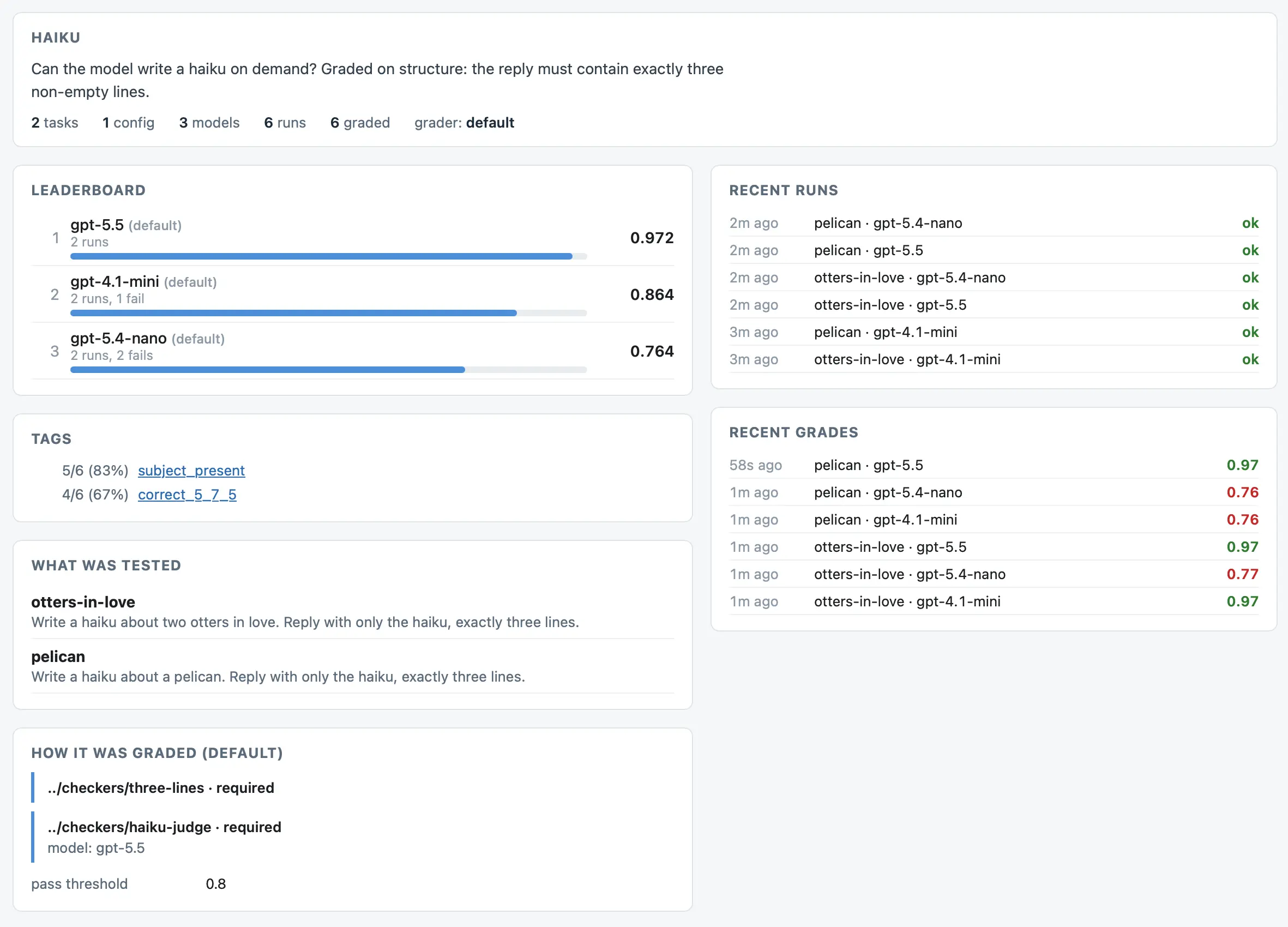
<p>Or run the <code>smevals build</code> command to build that report as static HTML, which you can then host anywhere. Here's <a href="https://static.simonwillison.net/static/2026/smevals-haiku-build/#/haiku">an example</a> showing an eval suite I built to evaluate how well models can write haikus.</p>
<p><img alt="Screenshot of an evaluation dashboard for a haiku-writing benchmark, testing whether models can reply with exactly three non-empty lines. A header describes the eval, with panels below showing a leaderboard ranking three GPT models by score, lists of recent runs and recent grades, tag pass rates, the two haiku prompts that were tested, and details of the graders used with a 0.8 pass threshold." src="https://static.simonwillison.net/static/2026/smevals-report.webp" /></p>
<p>The most time-consuming part of this project was figuring out the vocabulary for it! Here's what I settled on, quoted from the announcement:</p>
<blockquote>
<ul>
<li>An <strong>eval</strong> is a collection of challenges designed to answer a question about a model, for example, how good is that model at generating SVGs?</li>
<li>Each eval is a collection of <strong>tasks</strong>. A task is a specific challenge, for example "Generate an SVG of a pelican riding a bicycle".</li>
<li>When you run the eval you do so against one or more <strong>configs</strong>. Each config specifies a model to be evaluated, but may also include other parameters to test, such as different system prompts, model parameters, or agent harnesses.</li>
<li>A <strong>run</strong> records what happened when a specific config was used to execute a specific task. A <strong>runner</strong> is the script that executes a run.</li>
<li>Once you have collected one or more runs, you need to evaluate the results to see how well the model (or config) did. This is done by a <strong>grader</strong>, which produces a <strong>grade</strong>.</li>
<li>Each grader runs a sequence of <strong>checks</strong>. These can be simple operations, like checking for a specific string in the output, or confirming that the output is valid XML. They can also be more complicated custom operations (implemented as scripts called <strong>checkers</strong>), including using other models to answer questions about the run.</li>
</ul>
</blockquote>
<p>I've been trying to figure out an approach I like for evals for several years now. <code>smevals</code> is my third iteration on the idea and it feels right to me. I
分享
阅读原文 ↗