Daily Tech Briefing
AI 科技速览
每天 5 分钟内学习 AI。获取最新的人工智能新闻,理解其重要性,并学习如何将其应用于您的工作。
Latent Space · 2026/7/30 11:17:55
Ontologies Are So Back: Why AI Agents Are Reviving the Semantic Web
AI 中文解读
AI圈刮起怀旧风,这回翻红的是上世纪的概念“本体论”。加州大学伯克利分校教授Frank Coyle在AI工程师大会上提出,想让AI智能体更靠谱,光靠大模型的“猜”不行,还得给它装上“逻辑护栏”——也就是用“知识地图”来约束AI的行为。他管这叫“神经符号AI”,说白了就是让数学派的神经网络和传统符号派的规则系统组队干活。其实这个“知识地图”的概念早就有,比如网页开发老手熟悉的Schema.org就是现成的“地图”,而且大模型训练时已经读过这些数据,开发者直接调用就行,不用从零画图。Neo4j公司已经在这么干了,他们用三层“知识地图”帮企业管数据,就像给AI配了导航仪。这对普通人的意义不小:以后用AI处理复杂任务会可靠得多。以前AI可能凭感觉随便答,有了“地图”约束,它会按着知识脉络去核实信息,减少胡编乱造。比如问AI医疗建议或者让它帮你自动订票,它会更像拿着操作手册办事,而不是靠瞎蒙,用起来心里踏实多了。
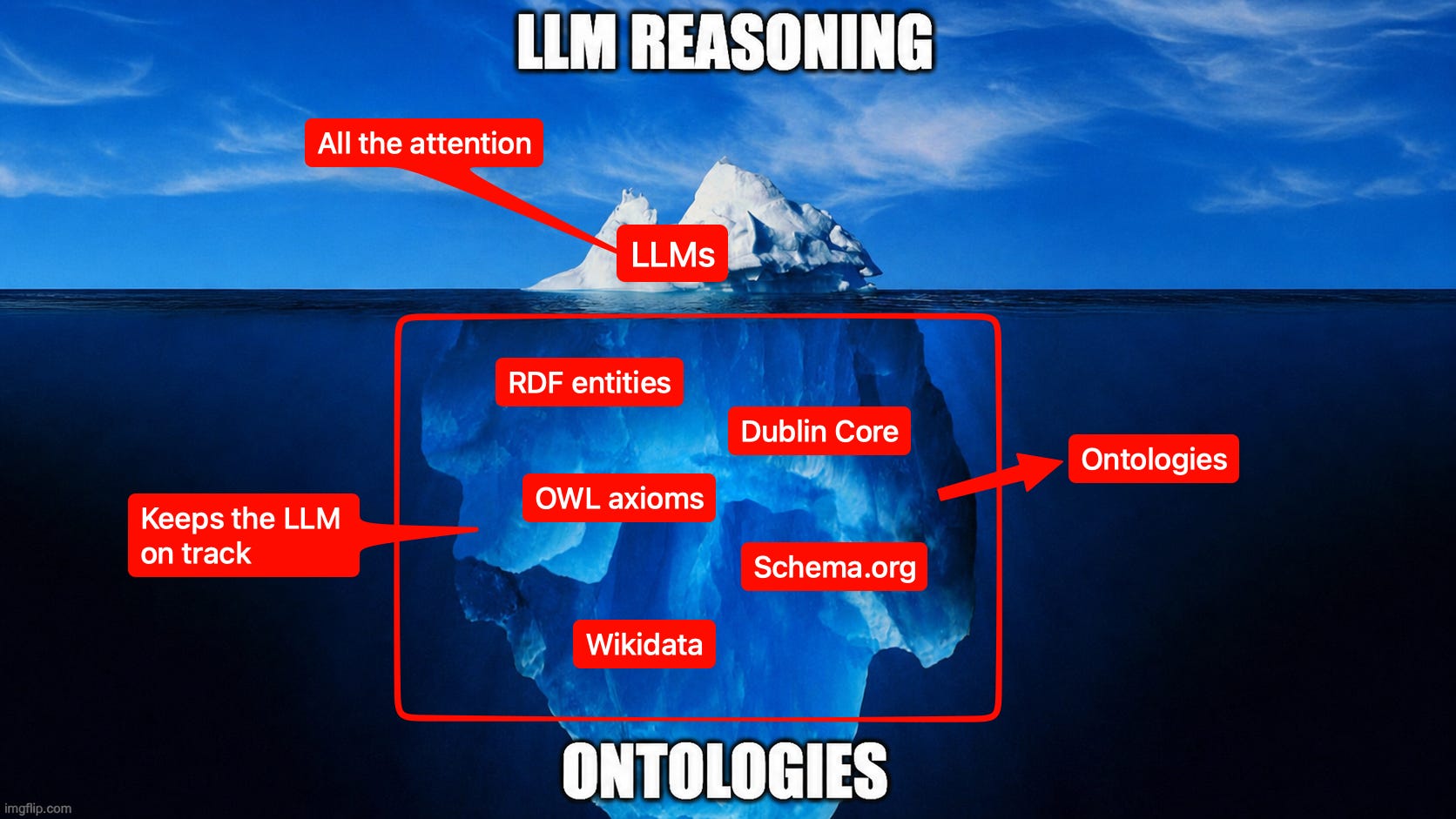
One of the most watched videos from the recent AI Engineer World’s Fair is a 20-minute talk by Frank Coyle, a professor of computer science who currently teaches generative AI and LLMs at UC Berkeley. Drawing on his decades of experience, Coyle re-introduced the concept and practice of ontologies to today’s AI engineers.Coyle argued that while LLMs are very effective at providing probabilistic reasoning, for agentic systems to be truly effective they need “logical guardrails” — by which he means ontologies.UC Berkeley professor Frank Coyle speaking at AIEWF 2026.In computer science, an ontology is “a description of data structure – of classes, properties, and relationships in a domain of knowledge” (as nicely defined by Oxford Semantic Technologies). Coyle himself defined an ontology as simply “data as graphs.” He added that ontologies as a concept go right back to Aristotle, and have been used throughout the history of Artificial Intelligence.The company Neo4j, known for its graph database systems, is also using ontologies in its agentic products.In a keynote session at AIEWF, Neo4j CEO Emil Eifrem talked about three different types of ontologies to enable a “smarter shared substrate” to run agents at scale. The first is a business-facing ontology, describing the key concepts in an organization; next is a technical ontology, which Eifrem described as “all the metadata of all the data sources and data assets in your enterprise ecosystem”; and finally execution traces, which are “the runtime signals out of your agent.”Neo4j’s ontology-based semantic layerWhat’s Old is New Again: the Semantic WebFrank Coyle thinks web ontologies are especially useful in building agentic systems. He mentioned Schema.org, FOAF, Dublin Core and other ontologies familiar to web developers — or at least, those of a certain vintage. He also mentioned “augmenting technologies” like RDFS (Resource Description Framework Schema) and OWL (Web Ontology Language).One benefit of using these established ontologies is that they’re already in the training data of LLMs, so developers can just prompt for them — much better than reinventing ontologies from first principles.“This stuff has been out there underlying a lot of what we already do,” Coyle said. “So take advantage of these things that already exist.”As an example, he showed a Claude agent loop which used an ontology to help validate the LLM’s reasoning after the tool had run.Coyle calls the convergence of probabilistic agents with ontologies “neurosymbolic AI.”“Sounds pretty fancy,” he said, “but it’s really neural networks tied into symbolic AI — rule-based systems come under that category, as do the knowledge graphs that we’re assembling.”He reiterated that neurosymbolic AI represents “a way to keep the LLM on its guardrails.”The Pros and Cons of OntologiesSomeone who has been steeped in ontologies for many years and is now combining that with AI engineering is Kingsley Idehen, who runs a company called OpenLink Software. He’s been building an “agent engineering stack” that uses Semantic Web technologies — including an “agent with RDF memory.” Kingsley Idehen’s agent-rdf-memory system.I asked Idehen to explain to me the benefits of ontologies.“The beauty of LLMs is that they are powerful processors of language,” he replied. “The beauty of an ontology is that it defines the types of entities and relationships through which language acquires computable context. Together, they bring the expressive power of language to computing’s UI/UX stack.”That makes a lot of sense, but if you’ve been a web developer for a while you’ll know the challenges of ontologies: maintenance and keeping them up-to-dat
分享
阅读原文 ↗