Daily Tech Briefing
AI 科技速览
每天 5 分钟内学习 AI。获取最新的人工智能新闻,理解其重要性,并学习如何将其应用于您的工作。
Hacker News · 2026/8/1 15:23:15
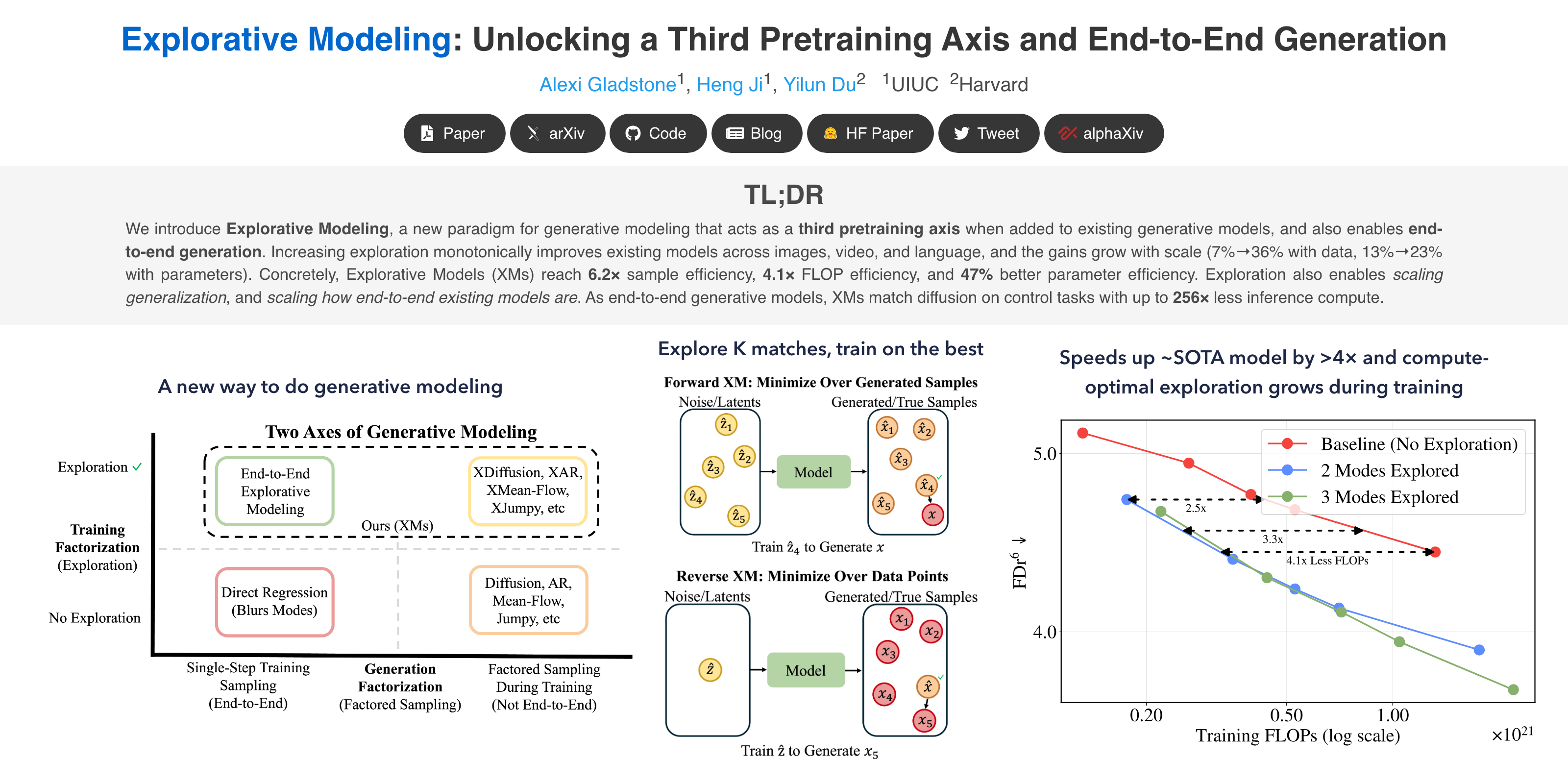
Explorative modeling: Train on the best of K guesses
AI 中文解读
AI训练又有了新突破!研究团队提出一种叫“探索式建模”的新方法,简单说就是让AI在生成图片、视频或文字时,不再只盯着一个“标准答案”硬猜,而是学会从大量可能性中主动探索最佳结果。以前AI直接预测时会“和稀泥”,比如让它画狗,它把成千上万张狗照片平均起来,结果画出一团棕色马赛克;现在这种方法能让AI越试越准,采样效率提升6倍多,计算开销也大幅降低。更厉害的是,这项技术可以直接叠加到现有AI模型上,无需推倒重来,无论是画图、写文章还是做控制任务,都能明显变强,而且数据越多、模型越大,提升越显著。对普通人来说,以后用AI画图、写文案会更逼真、更聪明,响应也更快;对开发者而言,则意味着更低的算力成本、更高效的模型训练,可能推动更多智能应用在手机甚至手表上流畅运行。
Website: https://explorative-modeling.github.io/ GitHub: https://github.com/alexiglad/XM TLDR: We introduce Explorative Modeling, a new paradigm for generative modeling that acts as a third pretraining axis when added to existing generative models, and also enables end-to-end generation. Increasing exploration monotonically improves existing models across images, video, and language, and the gains grow with scale (7%→36% with data, 13%→23% with parameters). Concretely, Explorative Models (XMs) reach 6.2× sample efficiency, 4.1× FLOP efficiency, and 47% better parameter efficiency. Exploration also enables scaling generalization, and scaling how end-to-end existing models are. As end-to-end generative models, XMs match diffusion on control tasks with up to 256× less inference compute. Let me start with a question that sounds simple. If I ask a model to “generate a dog”, how many correct answers are there? It turns out there are a lot… likely billions or more images that we could count as dog images. So what happens if we train a neural network to directly predict dog images? The model sees thousands of different valid dogs during training, and the single prediction closest to all of them is their average. That’s what the model learns to output, and the average of thousands of dogs looks nothing like a dog, it’s a brown blur. A real dog from the data → What the model predicts Figure 1: Training a model to directly predict images gives you the average of them all, a brown blur. This is why direct regression doesn't work for generative modeling. To make this concrete, let’s play a game. I’m going to throw darts at the board below, and each dart will land somewhere random on the rings. Your job is to guess where my next dart will land, and the further off you are, the worse your score. Figure 2: The dartboard for our game. So where should you guess? It turns out the guess that minimizes your error is the exact middle of the board.1 We trained a model to play this game, and sure enough, it guesses the middle every time (this is the optimal prediction here)! Figure 3: A model playing our game (blue) guesses the middle of the board. This is terrible though… the middle is almost never where a dart actually lands. The “optimal” guess is a spot that no darts ever land. This is the core problem of generative modeling. When a prediction has many valid answers, the best single prediction is their average, and the average of data is generally a bad answer that looks nothing like the real data.2 And this problem isn’t special to dartboards or dogs, it shows up with any kind of data. When we trained a model to directly generate three piles of 2D points, it predicted a single dot in the middle of them, and when we trained one on text, all it could say was “the”. Real data What the model predicts Real data What the model predicts Figure 4: Direct prediction collapses to the average on any kind of data. But wait. ChatGPT writes coherent text, and image models generate really amazing images. Clearly this problem has been solved somehow, right? It has, and every scalable generative model today solves it the same way, by breaking generation into many small steps during training, so each step has roughly one right answer. When a step has one right answer, there’s nothing to average, and the blur disappears. Let’s look at how this works. Autoregressive models (like LLMs) predict one piece at a time, which in our game means never guessing the dart’s exact position all at once. Instead, you first guess only how far left or right the dart lands, and then given that, you guess how far up or down. Once you know the dart landed on the far right, there are only a couple places it could be. Step 1: pick a left-right spot Step 2: pick up-down, given left-right Figure 5: Autoregression predicts one sequence element at a time. In our game, once the left-right position is chosen, the up-down prediction only has two small spots lef
分享
阅读原文 ↗