Daily Tech Briefing
AI 科技速览
每天 5 分钟内学习 AI。获取最新的人工智能新闻,理解其重要性,并学习如何将其应用于您的工作。
Hacker News · 2026/8/1 22:55:52
Unraveling the mysteries of habit formation
AI 中文解读
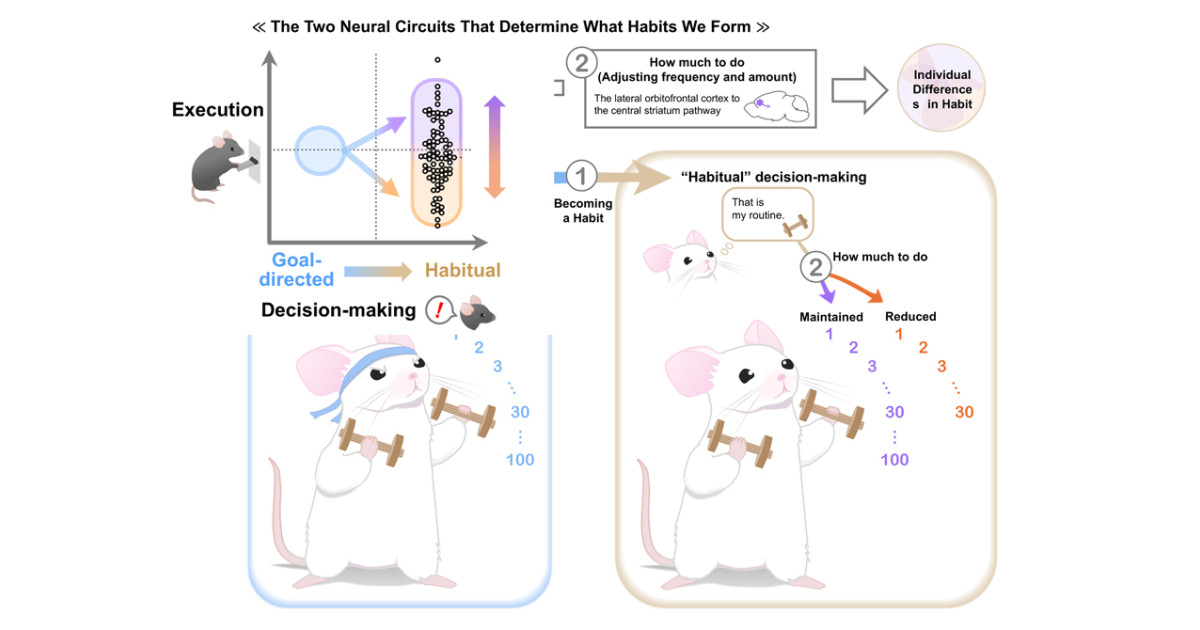
京都大学团队在小鼠实验中发现了习惯形成的“开关”和“音量键”:大脑中两套神经回路分别决定“会不会形成习惯”和“习惯执行得多卖力”。研究发现,前扣带回皮层到压后皮层的回路决定行为能否固化为习惯,而外侧眶额皮层到中央纹状体的回路则控制习惯的执行强度,这也能解释为什么有人能轻松养成好习惯,有人却总是半途而废。借助新的快速训练法,研究人员首次在小鼠身上全程实时追踪了习惯从无到有的神经变化过程,并成功通过人工干预来增强或抑制习惯行为。这一发现的意义在于,它为未来“掌控习惯”打开了大门——既然习惯的形成和执行受特定神经回路调控,理论上就有可能通过干预手段帮人更容易养成运动、学习等好习惯,或帮助戒除成瘾、强迫行为。当然,这项研究目前还停留在动物实验阶段,距离真正应用于人类还有相当距离,但它让我们对大脑这一“神秘功能”的理解迈出了扎实一步。
In other languages
日本語
In mice, two neural pathways in the brain determine habit-forming success and intensity
ターゲット
Corporations & Researchers
Published on
2026/07/28
Researchers研究者名Asaoka, NozomiActivity Database on Education and Research 研究者名Diane PaganoORCID 研究者名Hayashi, YasunoriActivity Database on Education and Research OverviewKyoto, Japan -- Habit formation describes the repeated performance of a behavior until it becomes routine: in other words, the shift from deliberate to automatic decision-making. This concept is often invoked as a way to improve one's life by making a routine of beneficial activities that can otherwise feel tedious, such as cleaning, studying, and regular exercise.That repeating the same behavior is essential for forming a habit has become well-established, but whether a habit develops as an exact replication of the original behavior, or if the behavior itself gradually changes as it becomes a habit, remains unclear. Because habit formation takes a long time, comparing behavioral and neural changes within the same subject before and after a habit develops has been difficult. To overcome this challenge, a team of researchers at Kyoto University developed a new training method that achieves rapid habit formation in mice, allowing them to track these transitions directly."Habits are one of the brain's most mysterious functions, and we often struggle to control them even though they are our own actions," says co-corresponding author Nozomi Asaoka. "By uncovering how habits work, we may eventually find ways to take control of them rather than letting them control us."Just like how humans develop habits, the team first trained subject mice to use goal-directed strategies, followed by an additional four-days of training designed to facilitate the adoption of habitual strategies. With this two-stage training approach, the researchers were able to assess the transition from goal-directed to habitual behavior in the brains of individual mice.The team discovered that two distinct neural circuits manage completely different aspects of habits. The first circuit, with neurons projecting from the anterior cingulate cortex to the retrosplenial cortex, determines whether a behavior becomes a habit, with its connections weakening during the transition. Crucially, the second circuit, from the lateral orbitofrontal cortex to the central striatum, controls how much the habit is executed, explaining individual differences. In this second circuit, habit-formed mice with strong neural responses maintained high behavioral execution levels, while those with weaker responses showed reduced execution. By artificially manipulating these pathways, the team was able to selectively promote habit formation or alter execution levels, proving the distinct roles of these two brain circuits.One key finding is that the habit formation process is much more complex than the traditional view that repetition simply replicates an action into a habit in its original form. In particular, the team demonstrated that even after a habit successfully forms, there are significant individual differences in the frequency and volume of that behavior."Our study has uncovered previously overlooked control mechanisms involved in habit formation, showing what determines how strongly a habit is carried out and helping explain why habits differ from person to person," says team leader Yasunori Hayashi.The team plans to expand their investigations to find out what drives these individual differences in habit intensity, hoping that better understanding may help us acquire more beneficial habits and improve treatment for problematic habits linked to conditions such as obsessive-compulsive disorder.
画像
分享
阅读原文 ↗