Daily Tech Briefing
AI 科技速览
每天 5 分钟内学习 AI。获取最新的人工智能新闻,理解其重要性,并学习如何将其应用于您的工作。
AWS ML Blog · 2026/7/31 19:53:04
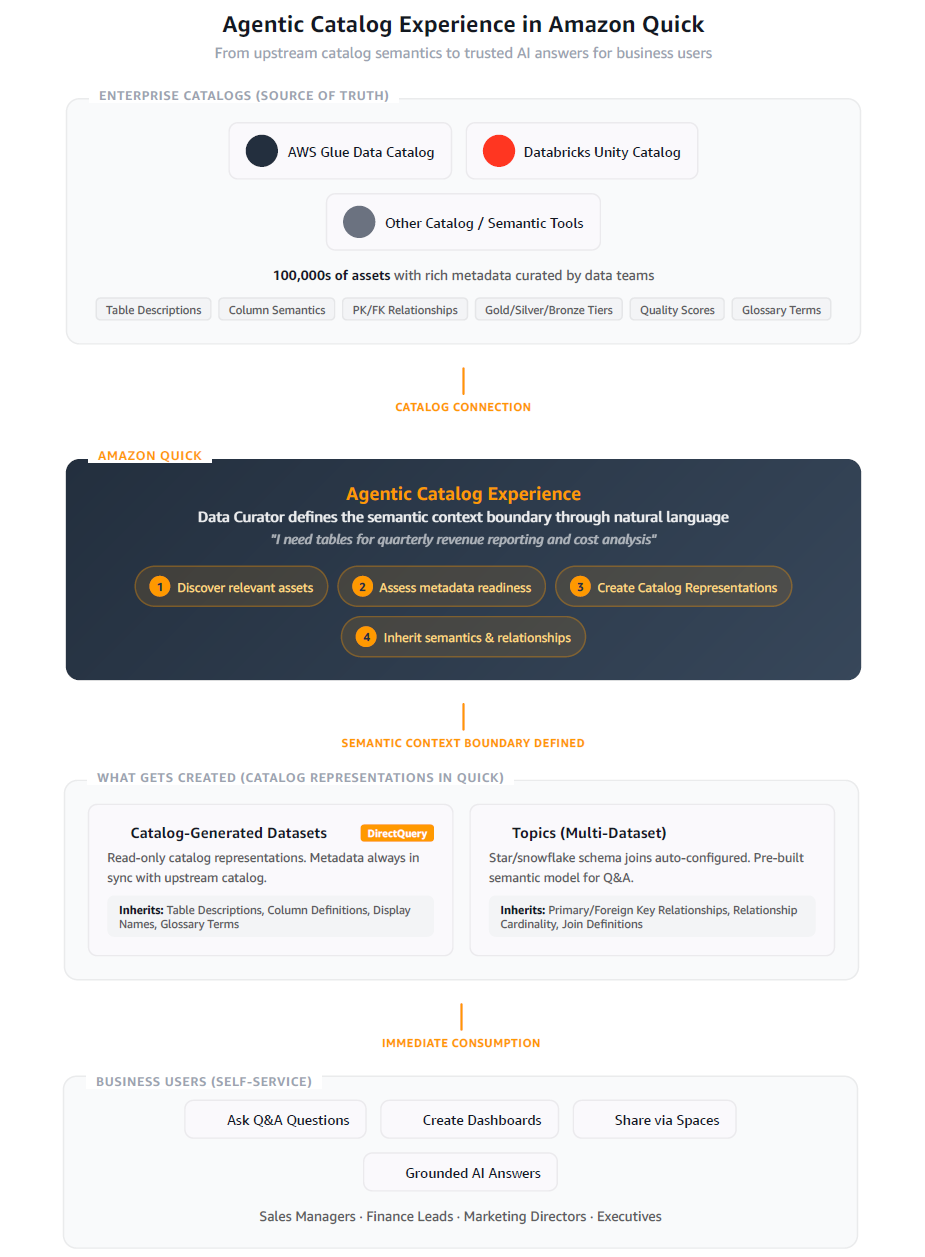
Announcing the Agentic Catalog Experience in Amazon Quick
AI 中文解读
核心亮点:亚马逊Quick这个BI工具终于能“读懂”企业数据背后的业务含义了,AI查数不再是瞎猜,而是直接调用数据团队已经定义好的标准规则。
通俗解读:以前用AI在BI工具里问“这个月收入多少”,不同部门对“收入”的定义可能不一样,有人算含税,有人算不含税。这就像让一个不了解公司内部规矩的新人去看报表。现在亚马逊Quick能直接连上企业背后的“数据说明书”,也就是在AWS Glue、Databricks这些底层系统里,管理员早已写好的字段说明和计算口径。相当于给这个AI新人发了一本内部操作手册,让它问什么都能按统一规矩来,不需要再重新摸索。
实际影响:对职场人来说,以后用自然语言查销售、财务、用户数据时,答案会明显更靠谱,不同部门看到的数字也能对得上,少了很多口径打架的扯皮。以前靠数据团队手工维护说明,动辄等上好几天,现在元数据会自动同步,很大程度上避免了定义过时导致的分析偏差。对企业而言,这项技术把能让一线业务人员更快获得可信数据,真正让数据决策在组织里跑得更通。
<p>As organizations embrace AI-powered analytics, the value of a natural language (Text2SQL) answer is only as good as the business context behind it. We’re entering a phase where semantic richness (table and column descriptions, and relationships) must flow directly from where it’s authored in upstream data catalogs and semantic tools into the AI products that serve end users. Products like Amazon Quick can no longer operate in isolation. They need to natively consume and reason over the definitions, relationships, and governance metadata that data teams curate in systems like AWS Glue Data Catalog and Databricks Unity Catalog. This shift from siloed metadata to connected, catalog-aware AI is what enables intelligent analytics at scale.</p>
<h2 id="the-challenge-bridging-the-last-mile">The challenge: Bridging the last mile</h2>
<h3 id="the-investment-is-done">The investment is done</h3>
<p>Enterprise data teams have done the hard work. They have invested heavily in upstream catalog platforms such as AWS Glue, Databricks Unity Catalog, Snowflake Horizon, Collibra, and dbt. On these platforms, they meticulously define table descriptions, column semantics, primary and foreign key relationships, glossary terms, and metric definitions.</p>
<p>Yet when it comes to enabling end users (such as sales managers, marketing directors, and finance leads) for production-ready AI and trusted dashboards, a significant gap remains.</p>
<h3 id="three-compounding-challenges">Three compounding challenges</h3>
<p>When data curators (business intelligence engineers, analytics leads, and senior analysts) need to enable their business users in Amazon Quick, they face three compounding challenges:</p>
<ol>
<li><strong>Limited discoverability</strong>: With thousands of tables in enterprise catalogs, discovering the right upstream assets that are curated and approved for reporting is a needle-in-a-haystack problem. There’s no way to describe what you need and have the system find it.</li>
<li><strong>Semantic fragmentation and manual recreation</strong>: Rich metadata that already exists upstream (business descriptions on tables and columns, and primary and foreign key relationships) does not flow through. Curators must recreate assets from scratch, redefine descriptions, and reconcile definitions manually. Does “revenue” mean gross or net? Does “active customer” mean a purchase within 30 days or 90 days? These definitions exist upstream but require manual re-entry.</li>
<li><strong>Time to insight in weeks, not hours</strong>: The combination of manual discovery and manual recreation means that the time from data to actionable insights stretches from hours to weeks. Worse, when upstream definitions change, manually created semantics in Quick Datasets become stale, causing semantic drift that erodes trust in AI answers and dashboards over time.</li>
</ol>
<h3 id="the-gap">The gap</h3>
<p>The problem isn’t upstream. The metadata exists. The governance is defined. The relationships are mapped.</p>
<p>The problem is the last mile: translating that rich catalog context into a curated, consumable experience that delivers grounded AI answers and deterministic dashboards end users can trust.</p>
<h2 id="introducing-the-agentic-catalog-experience-in-amazon-quick">Introducing the Agentic Catalog Experience in Amazon Quick</h2>
<p>Today, we’re announcing the Agentic Catalog Experience in Amazon Quick, an AI-powered workflow that helps data curators rapidly define their context boundary, inherit upstream semantics, and enable end users for grounded Q&A and trusted dashboards at scale.</p>
<p>At the heart of this experience is the Quick Agent, scoped to discovery, creation, and inheritance tasks within the catalog context. It uses the semantic context from the catalog connection to summarize the entire catalog at a glance, engage the customer in natural language conversation, surface the most relevant tables and relationships based on the c
分享
阅读原文 ↗