Daily Tech Briefing
AI 科技速览
每天 5 分钟内学习 AI。获取最新的人工智能新闻,理解其重要性,并学习如何将其应用于您的工作。
Nature Machine Intelligence · 2026/7/30 00:00:00
Reusability report: Exploring the utility and extensibility of an integrated modelling framework for liquid electrolyte design
AI 中文解读
1. 核心亮点:科学家给AI当“考官”,全面检验了一个能设计电池液体配方的AI模型,发现它不仅靠谱,还能轻松“转行”解决更多电池难题。
2. 通俗解读:以前有人搞了个AI,专门帮电池科学家设计里面的液体配方(就像调鸡尾酒一样)。但大家心里没底:这AI到底好不好用?换个场景会不会失灵?这次,研究团队就像找了个“考官”,对AI进行了严格测试——用不同数据量、不同类型的问题反复考验它。结果发现,这AI不仅预测准确,还能通过“零基础”或“少量学习”适应全新的电池配方和操作条件。更厉害的是,考官还给它“加了个外挂”,让它能从预测液体物理性质,一路扩展到计算电池能量效率和寿命,成绩远超传统方法。
3. 实际影响:以后开发手机、电动车电池时,科学家能更快地筛选出最佳液体配方。这意味着电池充电更快、更耐低温、续航更长、更不容易起火。我们普通人用电子产品时,可能会在未来几年里突然发现:咦,手机电池怎么耐用多了?电动汽车冬天也不掉电了?这些进步背后,就有这个AI模型的功劳。
Article
Published: 30 July 2026
Reusability report: Exploring the utility and extensibility of an integrated modelling framework for liquid electrolyte design
Genming Lai
ORCID: orcid.org/0009-0003-2959-48181,2,3 na1, Juntao Zhao1,2,3 na1, Zekai Liu1,2,3, Ruiqi Zhang
ORCID: orcid.org/0009-0003-2794-13101,2,3, Hanming Li
ORCID: orcid.org/0009-0000-4096-33441,2,3, Qiliang Zhang1,2,3, Fangchao Rong1,2,3, Chi Fang1,2,3, Qinghua Liu3, Yunxing Zuo
ORCID: orcid.org/0000-0002-2734-77204, Bo Xu5,6, Jiaxin Zheng
ORCID: orcid.org/0000-0001-5943-09351,2,3 & …Chuying Ouyang
ORCID: orcid.org/0000-0001-8891-16821,5,6 Show authors
Nature Machine Intelligence
(2026) Cite this article
Save article
View saved research
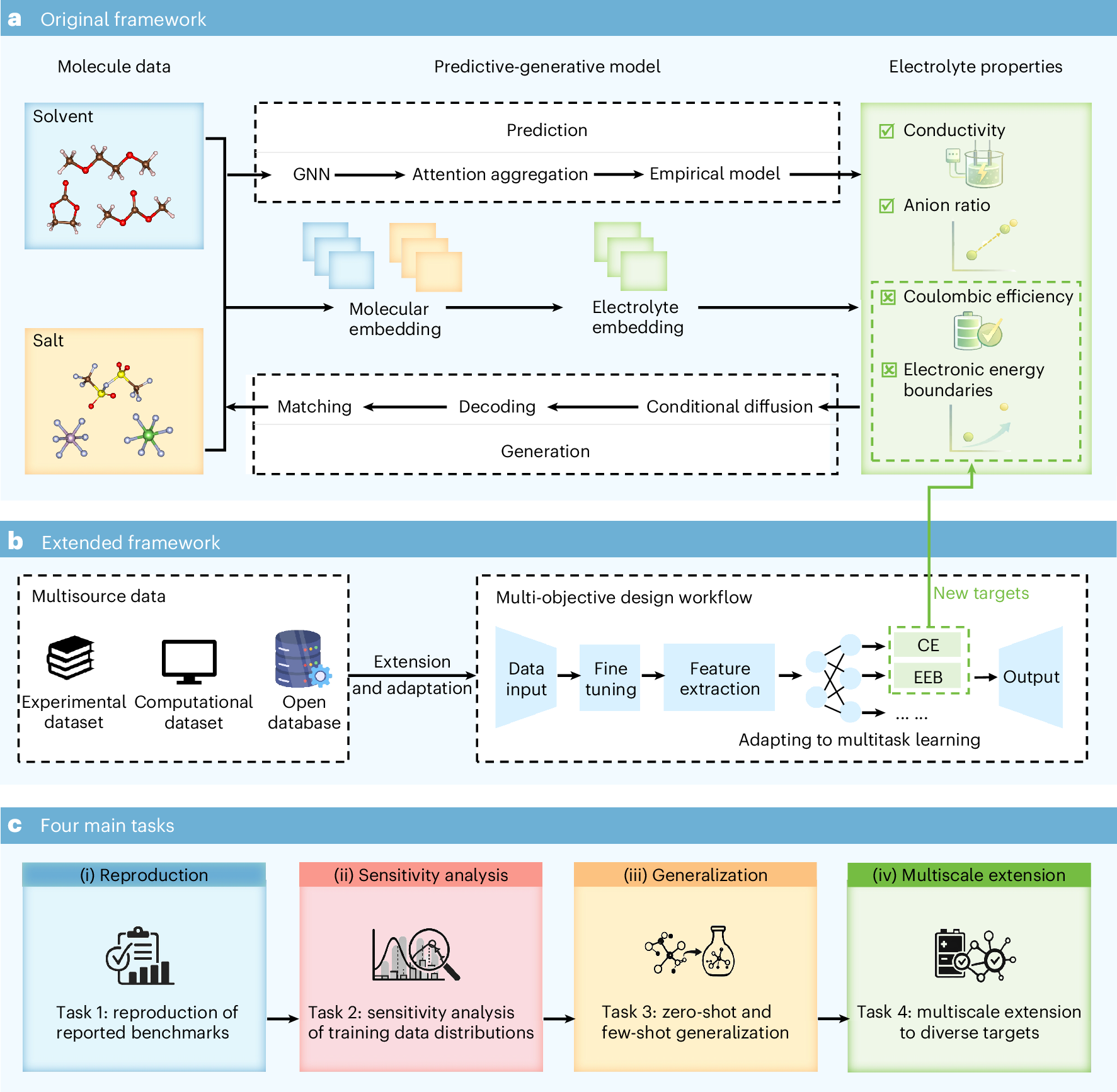
AbstractDespite rapid advances in machine learning-driven electrolyte design, the robustness, transferability and applicability of existing models remain insufficiently explored. Yang et al. recently introduced a unified machine learning framework for electrolyte formulation design. The framework adopts a physics-informed architecture that explicitly integrates molecular structural representations with formulation-level compositional information while preserving permutation invariance. By coupling forward property prediction with inverse generation, Yang et al. achieved accurate property prediction and efficient exploration of the formulation space. Here we present a systematic evaluation and multiscale extension of the framework proposed by Yang et al. We assess its robustness and reproducibility through rigorous benchmarking. We also reveal how training data size and compositional heterogeneity govern its applicability by quantifying its sensitivity to data distribution. Furthermore, we demonstrate cross-system transferability through zero-shot and few-shot learning across diverse operational regimes and novel electrolyte compositions. A multiscale extension of the framework has been implemented to encompass diverse targets, ranging from fundamental physical properties to electronic energy boundaries and battery Coulombic efficiency, where it substantially outperforms standard baselines. Overall, this work reveals both the potential and limitations of the framework proposed by Yang et al. across different systems and properties, and it establishes a reference for the reliable application and broader adoption of artificial intelligence-driven electrolyte design.
This is a preview of subscription content, access via your institution
Access options
Access through your institution
/* style specs start */
/* style specs end */
Access Nature and 54 other Nature Portfolio journals
分享
阅读原文 ↗