Daily Tech Briefing
AI 科技速览
每天 5 分钟内学习 AI。获取最新的人工智能新闻,理解其重要性,并学习如何将其应用于您的工作。
VentureBeat ML · 2026/7/29 20:40:15
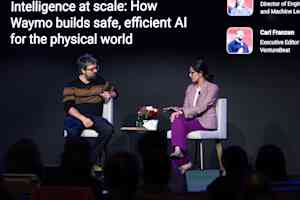
At Waymo, an AI project isn't ready until its evals are — not when the model performs well
AI 中文解读
Waymo给AI行业上了一课:模型再强,不如测试稳。这家自动驾驶公司明确表示,项目成熟与否不看模型表现,而是看评估体系是否完善。它们把评估从“上线前的最后检查”变成了贯穿始终的核心流程——训练时测、部署后测、模拟中测,甚至用真实路测数据不断检验。Waymo累计跑了2.2亿英里全无人驾驶,严重事故率比人类司机低17倍,靠的就是这套“评估驱动开发”的方法。
通俗来说,Waymo认为AI就像考驾照,不能只看在驾校开得多好,更要看上路后遇到加塞、行人突然冲出等突发情况时的反应。它们专门收集这些罕见但危险的场景做模拟测试,并且测试不会因为AI“毕业了”就停止——日常运营中还在持续评估,因为路况和用户行为会变。对普通人而言,这意味着未来你用的AI客服、理财助手或自动驾驶,在上岗前已经历了比普通人更严苛的“路考”,而且还在被实时监控。当AI犯错越来越少,我们才敢放心把更多生活决策交给它。
Few companies face higher stakes when deploying AI than Waymo, the self-driving car company under Alphabet that spun out of Google. Its models do not merely generate text or automate back-office tasks: They help vehicles navigate unpredictable streets, respond to human drivers and make split-second decisions in the physical world.But the methods Waymo uses to manage those risks — continuous evaluation, carefully curated data, human oversight and clearly defined business outcomes — offer a broader playbook for enterprises deploying AI agents in nearly any industry.Manasi Joshi, Waymo’s director of engineering for systems intelligence and machine learning, explained at VB Transform 2026 how the autonomous vehicle company trains, tests and deploys AI at scale. To date, Waymo has driven more than 220 million fully autonomous, or "rider-only," miles, with 17 times fewer serious crash injuries than human drivers over the same distance, according to the company. To achieve these impressive results, Joshi said Waymo has adopted what she called “eval-forced development” or “eval-centric development,” making evaluation a core part of engineering rather than a final check performed before deployment.“The stage at which our projects are maturing can be easily kind of transpired based on the eval maturity that they showcase,” Joshi said.In practice, Waymo assesses a project’s readiness partly by examining the maturity of the tests surrounding it. That approach has clear implications for enterprises building customer service agents, coding assistants, financial systems or other AI applications: If a company cannot reliably measure a system’s performance, it may not be ready to place that system into production.Evals must continue after launchJoshi said much of Waymo’s quality work has shifted toward evaluations, including tests conducted during model training, after training and inside open-loop and closed-loop simulations.“Eval is not a one-time task to launch a model,” she said.Waymo instead treats evaluation as a continuous process spanning driving, simulation and validation. Its methodology combines datasets, performance metrics and infrastructure capable of operating efficiently at scale.For enterprises, that means testing an agent before launch is insufficient. Teams must continue evaluating it as underlying models, business processes, user behavior and incoming data change. Those evaluations should also connect to actual business outcomes rather than relying solely on broad industry benchmarks.Joshi cautioned that model-quality measurements are only as trustworthy as the evaluation data behind them. Waymo therefore pairs its performance claims with information about the properties of the datasets used to test its systems.Testing the rare and dangerous casesWaymo’s evaluation hierarchy remains grounded in one overriding objective: safety.The company draws on first-party driving logs, some third-party data and realistic simulations that expose its systems to scenarios spanning billions of synthetic miles. Task owners choose specialized data and metrics for situations involving vulnerable road users, railroad crossings, construction zones and other complex environments.The same principle applies outside autonomous driving. Enterprises need to test not only the routine requests their agents handle successfully, but also uncommon situations where errors could create financial, legal, security or reputational damage.Joshi emphasized that Waymo does not leave release decisions entirely to automated systems. Its production-readiness reviews include extensive human oversight, while internal safety leaders approve software releases and service-area expansions.“This is not AI-driven and completely automated and zero human oversight,” she said. “Human lives are at stake.”Efficiency cannot come at the expense of reliabilityWaymo faces another problem familiar to enterprise AI teams: Demand for compute, storage, memory and network capacity is grow
分享
阅读原文 ↗