Daily Tech Briefing
AI 科技速览
每天 5 分钟内学习 AI。获取最新的人工智能新闻,理解其重要性,并学习如何将其应用于您的工作。
AWS ML Blog · 2026/7/29 15:34:18
Generate Autonomous Business Insights with AI Agent and MCP Servers
AI 中文解读
AWS推出AI代理与MCP服务器组合,让企业数据从“各自为政”变成“自动串联”,一键生成即时业务洞察。
想象一下,工厂经理每天早上要查看12条生产线、2000台机器的状态,但数据分散在物联网仪表盘、ERP系统、维修记录等多个孤岛里。以前她得手动登录不同系统、发邮件问同事、等CSV文件,折腾一个多小时才能拼出答案。现在AI代理就像一个全能助手,能自动登录所有系统,MCP服务器则像统一的数据“翻译官”,帮AI快速调用各个数据库。系统直接告诉她:“4号线马达温度偏高,可能是轴承磨损,需优先检修。”整个过程从几小时缩短到几十秒。
这项技术落地后,普通人也能感受到变化。比如仓库管理员不用再对着五个报表手动核对库存,AI会自动预警缺货风险;生产线上工人发现异常,直接对着手机提问,AI就能调取不同系统的历史数据给出判断。对企业来说,少了人工“拼图”的环节,决策效率翻倍,出错率也大大降低。说白了,AI终于不再是“只会回答单独问题”的玩具,而是成了能替你跑腿、整合信息的真帮手。
<p id="a-monday-morning-problem"><strong>A Monday morning problem</strong></p>
<p>Sarah Chen manages 12 assembly lines and 2,000 machines. Before her 10 AM production review, she needs one answer: <em>Which lines need attention this week?</em></p>
<p>Simple question. Painful journey.</p>
<p>She starts in the IoT dashboard. Line 4’s motor temperature is running 12°C above baseline — has been for three days. Calibration drift or bearing failure? The dashboard shows signals, not causes. So she pivots to the ERP system for maintenance history. Machine 42 had a bearing replaced eight months ago. Warranty says 12 months, but the operating hours log — buried in a separate historian database — shows it’s been running at 130% rated capacity since January.</p>
<p>That context exists nowhere in the IoT dashboard.</p>
<p>She pulls 30-day OEE trends. Line 4’s availability dropped from 94% to 87%. Line 9’s throughput also dipped 6%. Related? They share a coolant loop, but that relationship isn’t modeled in any system. She checks defect rates. Line 4’s scrap jumped 2.3% last Tuesday. Line 9 shows nothing — yet. Is the coolant theory wrong, or is Line 9 just lagging?</p>
<p>She emails three supervisors. By 11:15 AM, she finally has a confident answer.</p>
<p>Two floors down, Line Supervisor Raj Patel is doing the same exercise for Line 7 — except he can’t access the analytics dashboard. He’s working from a PDF export that’s three days stale. Maintenance Technician Priya Nair just wants to know if the vibration she flagged on Machine 42 last week has gotten worse. The data exists. She doesn’t have credentials to see it. She asks Raj. Raj asks Sarah’s analyst. A CSV arrives four hours later. By then, Priya has moved on to her next work order.</p>
<p>Three people. Three different access levels. Five disconnected systems. The same underlying data. Hours of manual stitching, context-switching, and waiting—for answers that should take seconds. The data existed but it just couldn’t speak in one voice.</p>
<h2 id="the-problem-data-rich-insight-poor">The problem: Data-rich, insight-poor</h2>
<p>The average enterprise runs five to eight operational and analytical systems daily. Each has its own login, its own query interface, and its own access model. When a manager needs a cross-system view — the kind that actually drives decisions — a human being becomes the integration layer. Traditional BI dashboards show what happened yesterday. Single AI assistants can answer isolated questions. But neither can autonomously coordinate across your entire technology stack to deliver contextual, actionable intelligence exactly when needed. Managing complex ETL pipelines, fragmented data stores and access patterns, and multiple AI assistants and agents lead to additional challenges for end users. Custom multi-agent frameworks can theoretically span the full stack, but building one from scratch requires months of engineering: custom connectors, session isolation, memory infrastructure, security code, scaling logic, and orchestration logic — all before the first business question gets answered.</p>
<p>Businesses should not need an engineering team just to ask questions about their own data. And the real cost is not engineering time — it is the decisions made on stale, partial information while the right answer was sitting in a system nobody had time to check.</p>
<h2 id="the-solution-configuration-not-code">The solution: Configuration, not code</h2>
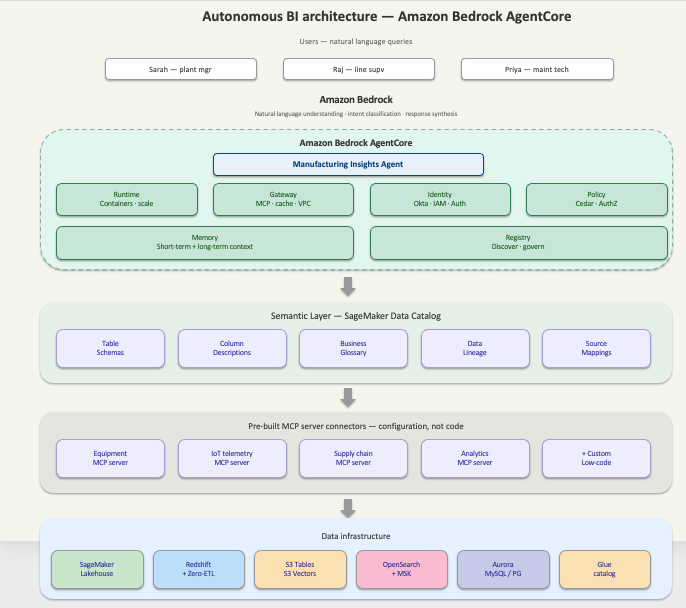
<p>Amazon Bedrock AgentCore flips the model. Instead of building an autonomous intelligence system from the ground up, you configure one. Amazon Bedrock AgentCore handles orchestration, security, memory, and scaling. You bring your data sources and your business rules. The result is a system where Sarah, Raj, and Priya can each ask natural language questions and get synthesized and personalized answers from across the entire technology stack — without knowing which system provided which piece of the answer.</p>
分享
阅读原文 ↗