Daily Tech Briefing
AI 科技速览
每天 5 分钟内学习 AI。获取最新的人工智能新闻,理解其重要性,并学习如何将其应用于您的工作。
HackerNoon AI · 2026/7/29 01:10:23
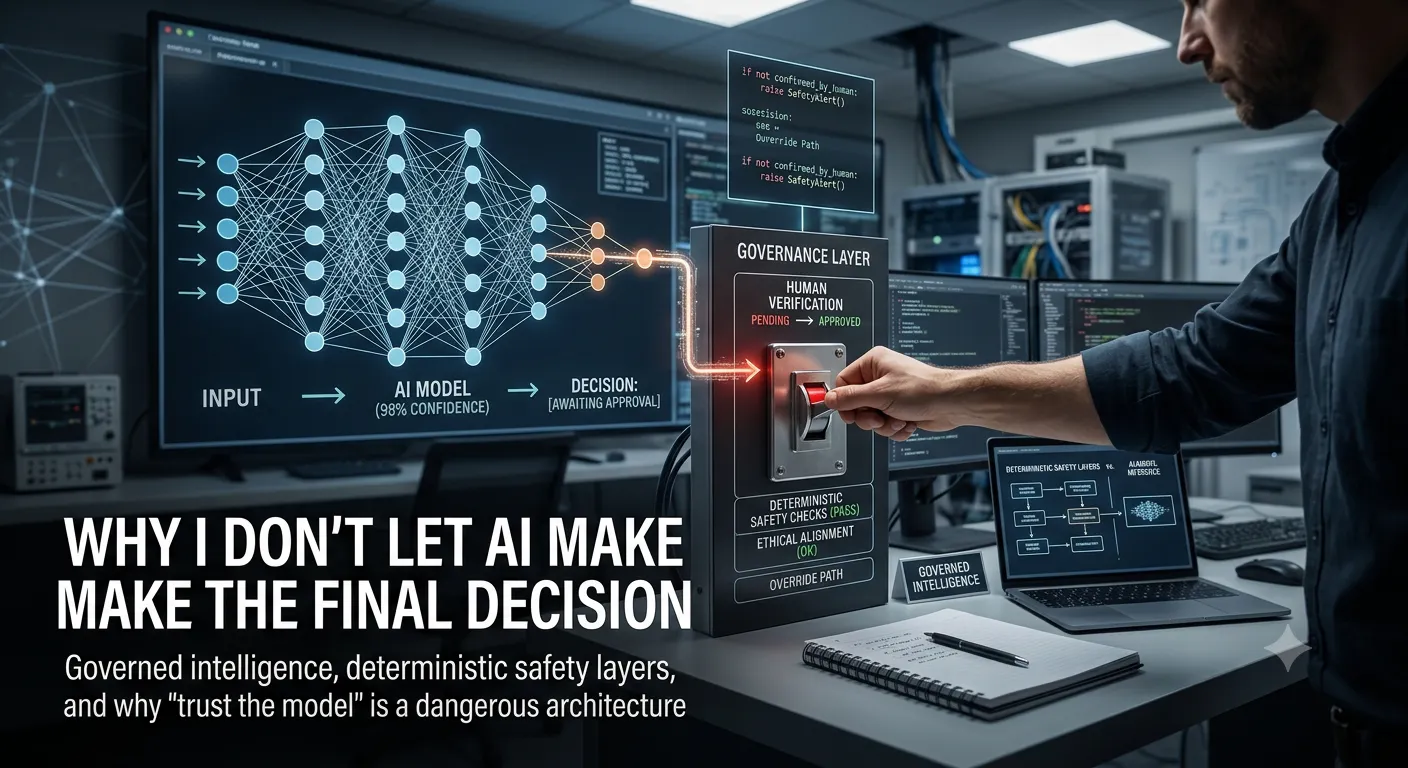
Why I Don't Let AI Make the Final Decision
AI 中文解读
当AI的准确率达到98%,你是否就会放心让它做决定?但一位资深的机器人工程师告诉你,恰恰是那2%的错误,可能带来灾难性后果。这篇来自HackerNoon的文章直击AI应用的核心盲区——模型性能不等于系统可靠性。作者参与过机器人导航、手语翻译等实际项目,发现最可靠的系统往往不是用了最好的模型,而是设计者明白:模型只是工具,不是决策者。
通俗来说,AI就像个特别自信的误报者:它可能99%的时间都正确,却在最关键的时候信誓旦旦地犯错。比如自动驾驶中,AI可能以极高置信度把白色卡车误判为云朵——这种错误在测试集里极少出现,但在真实世界里足以酿成大祸。作者打了个比方:把模型输出当真理,就像把所有天气预报都当绝对准一样危险。
这对普通人的启示很直接:使用AI辅助写作、翻译、购物推荐时,别把AI的答案当作最终决定。尤其是在医疗、金融、法律等需要承担后果的场合,一定要保持“人类最后把关”的环节。就像你让AI写一封重要邮件,可以借鉴它的思路,但一定要自己检查措辞和事实。未来最聪明的AI用户,不是那些会提问的人,而是那些知道什么时候该说“不”的人。
Discover AnythingSignupWrite New StoryWhy I Don't Let AI Make the Final DecisionbyOke Iyanuoluwa EnochbyOke Iyanuoluwa Enoch|@iyanuoluwa-007Robotics and AI Engineer specializing in ROS 2, Computer Vision, Machine Learning, and Embedded Systems.SubscribeJuly 29th, 2026TLDR Your browser does not support the audio element.Speed1xVoiceDr. One Ms. Hacker byOke Iyanuoluwa Enoch@iyanuoluwa-007byOke Iyanuoluwa Enoch|@iyanuoluwa-007Robotics and AI Engineer specializing in ROS 2, Computer Vision, Machine Learning, and Embedded Systems.SubscribeStory's CredibilitybyOke Iyanuoluwa Enoch|@iyanuoluwa-007Robotics and AI Engineer specializing in ROS 2, Computer Vision, Machine Learning, and Embedded Systems.SubscribeStory's CredibilityEveryone wants to talk about how smart the model is.
Nobody wants to talk about what happens when it is wrong. That gap, between model performance and system reliability, is where most AI products quietly collapse. And it is the thing I think about most when I am building anything that is supposed to work in the real world at production quality. I have worked across robotics perception, embedded systems, autonomous navigation, and product-scale AI systems, including Sentinel Quant, a human-in-the-loop portfolio management platform, and Signlytic, a bidirectional British Sign Language translation system combining computer vision, large language models, and voice synthesis. In every single one of those contexts, the same pattern appeared: the most reliable systems were never the ones with the best models. They were the ones whose designers understood, early, that a model is not a decision-maker. It is a component. That distinction sounds small. It changes everything.The core problem with "trust the model."
AI models are probabilistic by nature. That is not a flaw. It is just what they are. But probabilities become dangerous the moment they are mistaken for authority.
A model can be:
highly accurate on your test set and still fail on inputs that sit slightly outside the training distribution
confident and wrong at the same time, because calibration and accuracy are not the same thing
fast in development and completely unusable on edge hardware after deployment
correct 98% of the time and catastrophically incorrect the other 2%, specifically in the cases where correctness matters most
This is why "trust the model" is not a system design principle. It is an absence of one. Consider even something as conceptually clean as object detection. In my CARLA-based perception work using YOLOv11 with ByteTrack and StrongSORT, the model outputs a detection with a bounding box, a class label, and a confidence score. That confidence score is not a guarantee. It is a probability estimate. And in a live robotics system, acting on every detection above some arbitrary threshold without downstream validation is how you get a robot that makes confident, fast, wrong decisions. A responsible pipeline does not treat model output as truth. It treats it as a hypothesis that still needs to survive a gauntlet.What a governed AI system actually looks like
The architecture I return to across robotics, fintech, and language systems is always some variation of this:
Raw input
|
[Model inference] <-- probabilistic, fast, flexible
|
[Confidence threshold] <-- gate: is this output trustworthy enough?
|
[Deterministic rules] <-- hard constraints: safety, policy, physics
|
[Human review layer] <-- triggered when uncertainty is above threshold
|
[Logging and audit] <-- full trace, always
|
Action or output
Each layer does something different. The model is good at pattern recognition and generalisation. The deterministic layer is good at enforcing constraints that must never be violated, regardless of what the model thinks. The human layer handles uncertainty that neither of the above can resolve reliably. And the logging layer makes the whole thing inspectable.
Remove any one of these, and you have a wea
分享
阅读原文 ↗