Daily Tech Briefing
AI 科技速览
每天 5 分钟内学习 AI。获取最新的人工智能新闻,理解其重要性,并学习如何将其应用于您的工作。
HackerNoon AI · 2026/7/24 06:20:03
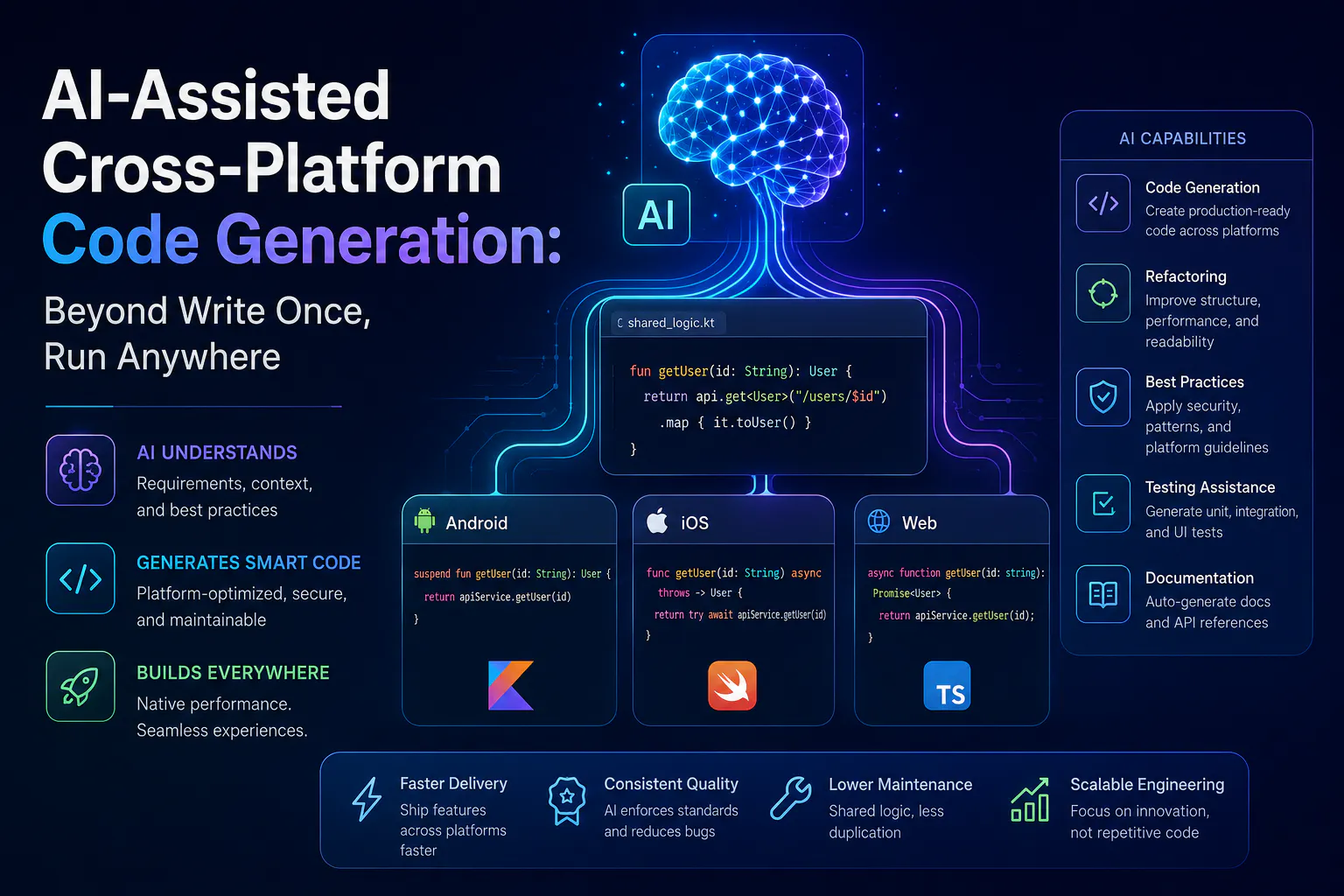
AI-Assisted Cross-Platform Code Generation: Beyond Write Once, Run Anywhere
AI 中文解读
AI正在改写跨平台开发的旧规则:不再幻想“写一次到处运行”,而是让AI自动为不同平台生成专属代码,真正把精力从重复劳动中解放出来。
过去,开发者要为一个App适配iOS、安卓等多个系统,要么写多套代码,要么用笨重的统一方案,结果总是不尽如人意。现在,AI助手可以读懂整个项目文件,根据开发者定义好的“共享逻辑”和“平台接口”,自动生成各平台需要的原生代码。比如,你只需指定数据怎么处理、界面怎么交互,AI就能在背后搞定Android的Java层和iOS的Swift层,甚至自动检查代码冲突。
这项变化对普通人最直接的影响是:App开发成本大幅降低,产品迭代更快。你手机上的跨平台应用,比如用React Native或Flutter开发的应用,将更流畅、更少bug,因为AI生成的代码更精确地利用了各平台的原生能力。未来,那些“小团队做不了大App”的鸿沟会逐渐缩小,更多创新应用能以更低成本来到你面前。
Discover AnythingSignupWrite 328 readsAI-Assisted Cross-Platform Code Generation: Beyond Write Once, Run AnywherebyFlaregun-devbyFlaregun-dev|@uthejdeveloperThis is thej, a software dev currently working on a startup app. Trying to find people to join the journey as wellSubscribeJuly 24th, 2026TLDR Your browser does not support the audio element.Speed1xVoiceDr. One Ms. Hacker byFlaregun-dev@uthejdeveloperbyFlaregun-dev|@uthejdeveloperThis is thej, a software dev currently working on a startup app. Trying to find people to join the journey as wellSubscribebyFlaregun-dev|@uthejdeveloperThis is thej, a software dev currently working on a startup app. Trying to find people to join the journey as wellSubscribeCross-platform development has always promised leverage, but production software has rarely matched the fantasy of one codebase erasing every platform difference. Modern frameworks already reflect that reality. React Native renders through native platform APIs instead of emulating widgets, Flutter documents platform channels and Pigeon for structured host integration, and Kotlin Multiplatform explicitly supports selective sharing of business logic, UI, or both, while keeping escape hatches for native code when needed. At the same time, coding agents have moved beyond autocomplete into repo-aware systems that read codebases, edit files, run commands, and prepare pull requests. The result is a different model of cross-platform engineering not one universal artifact, but AI-assisted generation of shared logic, typed adapters, and platform-specific implementations from a controlled set of contracts.
Cross-Platform Development Has Become Selective, Not Absolute
The phrase “write once, run anywhere” has become less useful than “share deliberately, specialize explicitly.” Kotlin Multiplatform’s current guidance recommends separating app entry points from shared modules and, when necessary, splitting shared business logic from shared UI so native presentation layers do not inherit unnecessary dependencies. React Native’s New Architecture makes the same point from a different direction such as typed specifications define the boundary, and Codegen generates Android and iOS interfaces from that specification. Flutter reaches a similar destination with Pigeon, which generates structured, type-safe channel code rather than relying on manually coordinated string-based messaging. The common thread is that the winning abstraction is not universal rendering. It is typed intent with controlled native seams.
That change matters because AI is strongest where the problem is high-volume, repetitive, and constrained by contracts. Real software engineering evaluation has already moved far beyond single-function completion. SWE-bench was created from real GitHub issues and corresponding pull requests, and its authors emphasize that these tasks require coordinated edits across multiple files, long contexts, and execution-aware reasoning. Code-oriented models have likewise advanced toward long-context reasoning and infilling rather than mere next-token completion. In practice, this means AI is increasingly useful for generating the predictable parts of cross-platform systems, such as DTOs, validation layers, adapter code, test scaffolds, and native bridge stubs, while humans still define the architectural boundaries and review the semantic correctness of the result.
Typed Contracts Are the Real Source of Reuse
The most reliable pipeline starts from a machine-checkable contract rather than a natural-language prompt alone. OpenAI’s Structured Outputs feature is designed to keep model responses aligned with a supplied JSON Schema, which makes it practical to ask a model for a feature manifest instead of raw source files. That manifest can then drive deterministic generators for Kotlin Multiplatform modules, React Native native specs, Flutter Pigeon definitions, or web clients. In other words, AI should produce the intent model, while standard build tooling
分享
阅读原文 ↗