Daily Tech Briefing
AI 科技速览
每天 5 分钟内学习 AI。获取最新的人工智能新闻,理解其重要性,并学习如何将其应用于您的工作。
HackerNoon AI · 2026/7/27 21:01:10
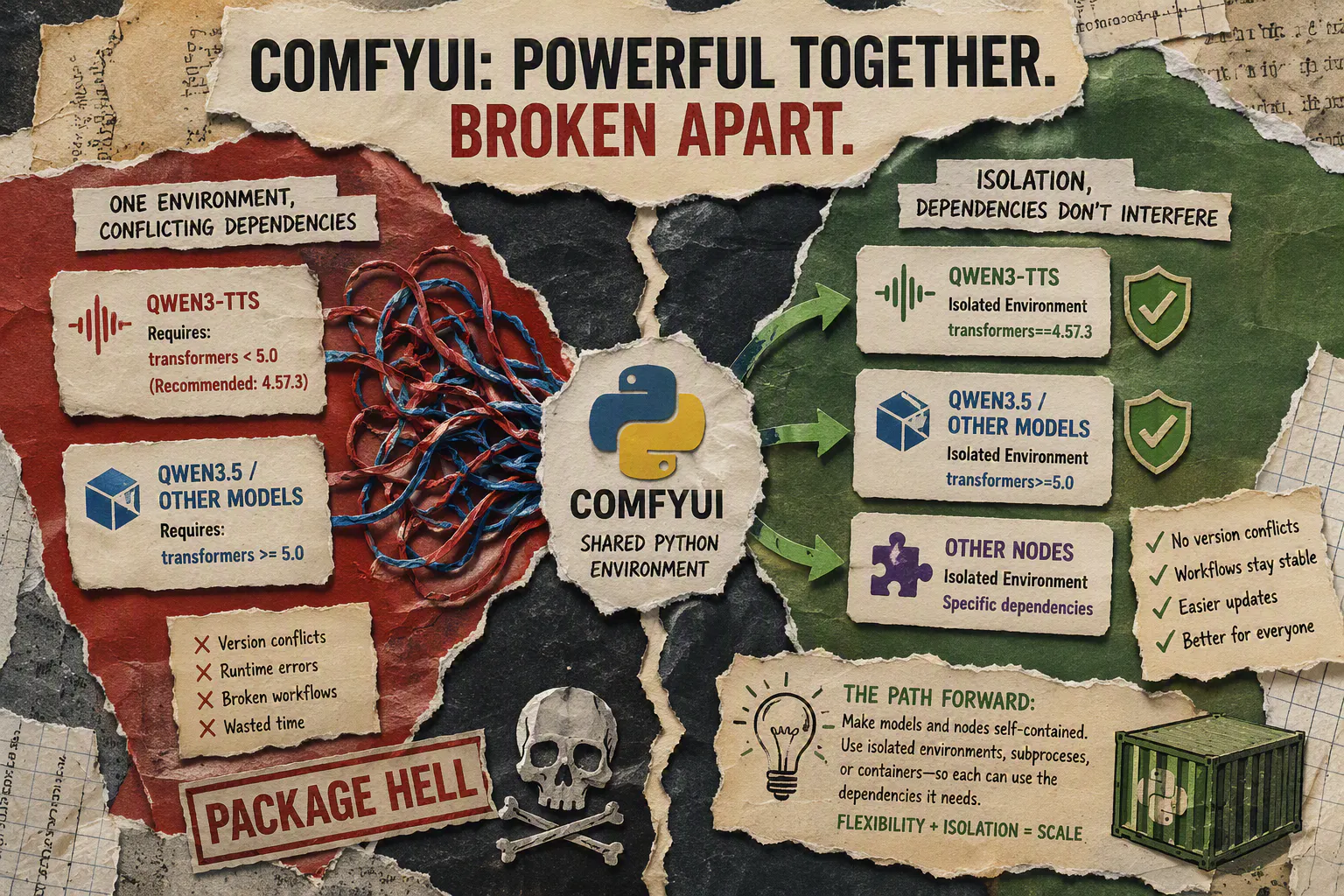
ComfyUI, Package Hell, and Dependency Isolation: What You Need to Know
AI 中文解读
ComfyUI作为本地运行生成式AI的最灵活前端工具,如今却因为“包地狱”问题让用户头疼不已——简单来说,就是不同的AI模型和插件共用一套运行环境,就像多个厨师挤在一个厨房里抢锅勺,很容易互相打架。
通俗解读一下:ComfyUI靠节点式工作流让用户轻松搭建图像、音频、视频等AI应用,功能强大且社区资源丰富。但它把所有自定义节点和模型都塞进同一个Python系统里,这就埋下了隐患。比如你刚装了一个最新音频模型,它要求某个基础软件包是5.x版本,可另一个老旧模型却只支持4.x版本,一升级就能把旧模型搞瘫痪。文章作者就亲历了Qwen3-TTS语音模型和Transformers新版不兼容的尴尬,官方甚至专门警告用户要锁定旧版本才能用。
这对普通用户意味着什么呢?如果你只是玩玩简单的文本生图,可能还没感觉;但一旦你想尝试各种新奇功能,比如同时玩语音合成和最新的多模态模型,就得时刻留心版本冲突。装一个新插件可能莫名其妙让另一个功能报错,修复起来很麻烦。这提醒我们,AI工具越来越强大,但“兼容性管理”也成了绕不开的日常功课,开发者或许该考虑给不同模型分配独立环境,就像每个厨师有自己的专用厨房。
Discover AnythingSignupWrite New StoryComfyUI, Package Hell, and Dependency Isolation: What You Need to KnowbyAlan BonnicibyAlan Bonnici|@chribonnTech professional exploring cloud, cybersecurity, and AI.
Sharing insights, research, and real-world perspectives.SubscribeJuly 27th, 2026TLDR Translations ENTRBNESJAHEHTELMNKKNLPSROENTRBNESJAHEHTELMNKKNLPSROYour browser does not support the audio element.Speed1xVoiceDr. One Ms. Hacker byAlan Bonnici@chribonnbyAlan Bonnici|@chribonnTech professional exploring cloud, cybersecurity, and AI.
Sharing insights, research, and real-world perspectives.SubscribeStory's CredibilitybyAlan Bonnici|@chribonnTech professional exploring cloud, cybersecurity, and AI.
Sharing insights, research, and real-world perspectives.SubscribeStory's CredibilityA Great Tool Made Easy
ComfyUI has become one of the most flexible front ends for running generative AI models locally. Its node-based workflow system allows users to build anything from simple image generation pipelines to highly sophisticated audio, video, and multimodal workflows.
The project is also exceptionally well supported. ComfyUI benefits from a large and active community, extensive official documentation, and a built-in Manager for discovering and installing custom nodes. On top of that, there is an enormous collection of community-created workflows, tutorials, and videos covering everything from a first text-to-image generation to advanced production pipelines. Whatever you're trying to accomplish, someone has usually already published both a workflow and a guide for it. Getting started with AI locally has arguably never been easier. Personally, I run the ComfyUI Easy Install distribution, which packages ComfyUI into a portable, preconfigured environment that can be deployed with minimal setup. It's an excellent option for users who want to get up and running quickly without manually configuring Python environments and dependencies. However, the very thing that makes ComfyUI so powerful—its vast ecosystem of custom nodes and models—is also creating a problem that the software industry has encountered before.One Codebase, Many Masters
ComfyUI runs every model and custom node within a single shared Python environment. Each node brings its own dependencies, and all of those dependencies must coexist within the same installation.
That arrangement works well until two models require incompatible versions of the same package. At that point, installing or updating one component can silently break another. I primarily use ComfyUI for audio-related work, and recently encountered a good example of this problem:
Qwen3-TTS is incompatible with Transformers 5.x and above. Its maintainers explicitly recommend using transformers==4.57.3, warning that version 5 introduces breaking API changes that can lead to model loading failures and runtime errors.
At the same time, newer models are increasingly being built around Transformers 5.x. Support for recent model families, such as Qwen3.5, only became available in newer versions of the library, creating the exact opposite requirement.
As a result, one workflow may require a version of Transformers below 5, while another requires version 5 or higher. There is no single installation that can satisfy both requirements simultaneously. Making one workflow work can easily break another. If each model operated within its own isolated environment, this conflict would simply not exist. Transformers is only one example. Similar issues arise with packages such as huggingface_hub and numerous other Python dependencies. A workflow that worked perfectly last week can suddenly fail after installing a new node or updating an existing one. Users who are unfamiliar with Python dependency management often find themselves confused when a previously stable setup begins throwing seemingly unrelated errors. The result is a cycle of fixing one workflow only to break another—a pattern that is becoming increasingly
分享
阅读原文 ↗