Daily Tech Briefing
AI 科技速览
每天 5 分钟内学习 AI。获取最新的人工智能新闻,理解其重要性,并学习如何将其应用于您的工作。
SiliconANGLE AI · 2026/7/28 02:17:08
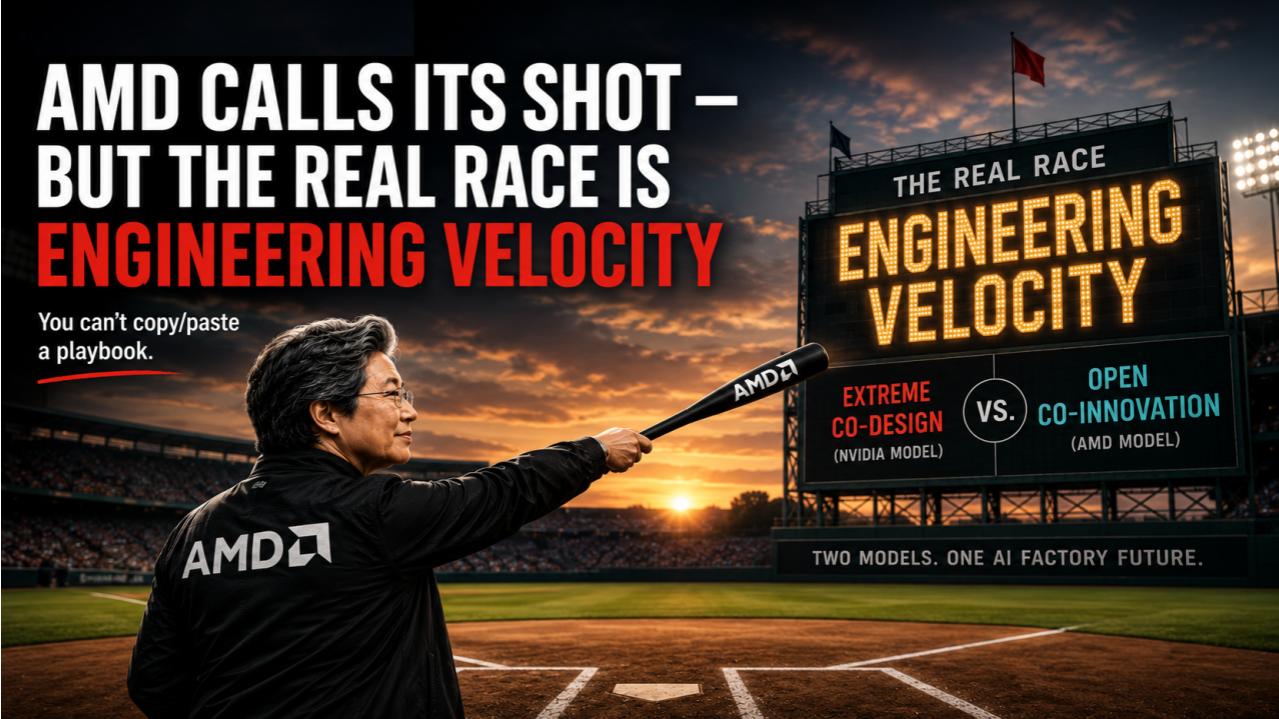
AMD calls its shot, but the real race is engineering velocity
AI 中文解读
AMD在最新的Advancing AI活动上高调宣布,要在CPU、GPU、机架级性能、网络带宽等全方位超越英伟达。但真正引人深思的并非这些豪言壮语,而是两家公司背后比拼的“工程速度”——谁能将芯片设计、软件开发、客户反馈和AI辅助工具融合成一台快速迭代的“工程机器”,谁就能持续推出更优的AI平台。AMD主张开放合作模式,英伟达则信奉极致协同设计,但最终胜负不取决于发布会上的跑分,而是谁能更快地让整个系统学习、验证并不断进步。对普通人而言,这场竞争意味着AI基础设施成本可能加速下降,未来无论是手机上的语音助手、企业里的智能客服,还是自动驾驶的决策系统,都能以更低价格获得更强性能。我们可能不再需要忍受“慢”AI,而工程速度的赢家将让智能服务变得更快更可靠。
UPDATED 22:17 EDT / JULY 27 2026
AI
AMD calls its shot, but the real race is engineering velocity
BREAKING ANALYSIS by
Dave Vellante
At AMD’s Advancing AI event, Lisa Su called her shot – just like Babe Ruth. The question now is whether AMD has built the engineering machine to hit it. Last week, we argued that AMD’s next reinvention did not require it to beat Nvidia. Rather, we said, the company needed to become the indispensable second platform in a rapidly expanding AI infrastructure market. That thesis was well received. But at Advancing AI, Lisa Su raised the stakes considerably.
AMD didn’t present its new products like Venice, Instinct MI455X, Helios and ROCm as “respectable alternatives.” It claimed outright leadership across CPUs, GPUs, rack-scale performance, memory capacity, network bandwidth and tokens per dollar. And it extended the argument across enterprise AI, robotics, ultra-low-latency inference and a rapidly expanding partner ecosystem.
The obvious narrative coming out of the event is whether AMD’s model of Open Co-Innovation can match Nvidia’s Extreme Co-Design. We initially framed the debate that way ourselves. But we now believe that is only a surface-level debate.
In fact, we think the real race is what we’re calling Engineering Velocity – i.e. which organization can turn silicon, software, development infrastructure, automated validation, customer feedback and increasingly AI-assisted engineering into the fastest continuously improving platform.
In this Breaking Analysis, we’ we’ll compare those two organizational models, define the emerging engineering factory, examine the technical evidence surfaced by SemiAnalysis, quantify AMD’s networked partner strategy, separate benchmark claims from production reality, and assess whether Helios can convert Lisa Su’s ambition into sustained customer outcomes.
Because in AI infrastructure, the winner may not be the company with the best benchmark on keynote day. It will more likely be the company whose engineering system learns, validates and improves the entire platform, faster than anyone else.
Watch the full video analysis
Sharpening the premise
Last week, we posited that AMD did not have to beat Nvidia. It only had to become the indispensable second AI platform in a huge market growing fast enough to support more than one major winner.
At Advancing AI, Lisa Su effectively raised the ambition well beyond our initial thinking. Specifically, AMD claimed leadership across CPUs, GPUs, rack-scale systems, memory capacity, network bandwidth and tokens per dollar – with direct callouts against Nvidia. So the obvious debate coming out of the event was whether AMD’s model of Open Co-Innovation could match Nvidia’s Extreme Co-Design.
That was our initial framing as well at the event. But believe that is the surface-level debate.
A deep technical analysis from SemiAnalysis helped expose something deeper. Their work argues that AMD’s software progress is real – but that the limiting factor is increasingly not engineering talent. It is engineering infrastructure – i.e. stable internal GPU clusters, continuous integration, automated validation and enough testing capacity to support a rapidly expanding number of AI coding agents.
SemiAnalysis deserves credit for identifying that operational constraint. But, we think the observation points to a much larger competitive dimension. The real race is what we’re calling Engineering Velocity. Engineering Velocity is not a third strategy. It is the competitive outcome for which both organizational models are attempting to optimize.
Nvidia pursues it through Extreme Co-Design, which is a tightly integrated engineering
分享
阅读原文 ↗