Daily Tech Briefing
AI 科技速览
每天 5 分钟内学习 AI。获取最新的人工智能新闻,理解其重要性,并学习如何将其应用于您的工作。
AWS ML Blog · 2026/7/23 16:30:20
Agentic retrieval for Amazon Bedrock Managed Knowledge Base
AI 中文解读
亚马逊Bedrock知识库推出智能检索新功能!核心亮点是:它不再像传统搜索那样只给你一堆零散结果,而是像人类分析师一样自动拆解复杂问题,逐步搜索再综合回答。通俗来说,以前你问“对比公司2020年和2023年的战略变化”,传统搜索引擎只会返回一堆可能相关的段落,其中还夹杂着无关信息;现在AI会先分别查找这两年的人力、投资、客户至上等具体内容,把结果拼起来再给你一个完整答案。这对普通用户的影响很实在:企业员工分析年报、市场报告或客服记录时,原本需要多次手动搜索、反复核对,现在一句话就能拿到综合分析,效率大幅提升,尤其适合那些需要对比、归纳或探索性提问的场景。
<p>Your users ask multi-part, comparative, and exploratory questions that span PDFs, slides, tickets, transcripts, and web content. Classic single-shot retrieval breaks down on these questions. Answers miss context, support tickets escalate, and analysts waste hours re-running searches. Agentic retrieval for <a href="https://aws.amazon.com/bedrock/knowledge-bases/" target="_blank" rel="noopener">Amazon Bedrock Managed Knowledge Bases</a> is designed for these questions.</p>
<p>Consider two questions an analyst might ask: “Compare our 2020 and 2023 strategy. What changed?” and “What are the three biggest risks across product lines?” Neither is a single-shot lookup. A multi-intent question has no single point in embedding space that represents it well, so top-k chunks come back as an average of competing sub-intents.</p>
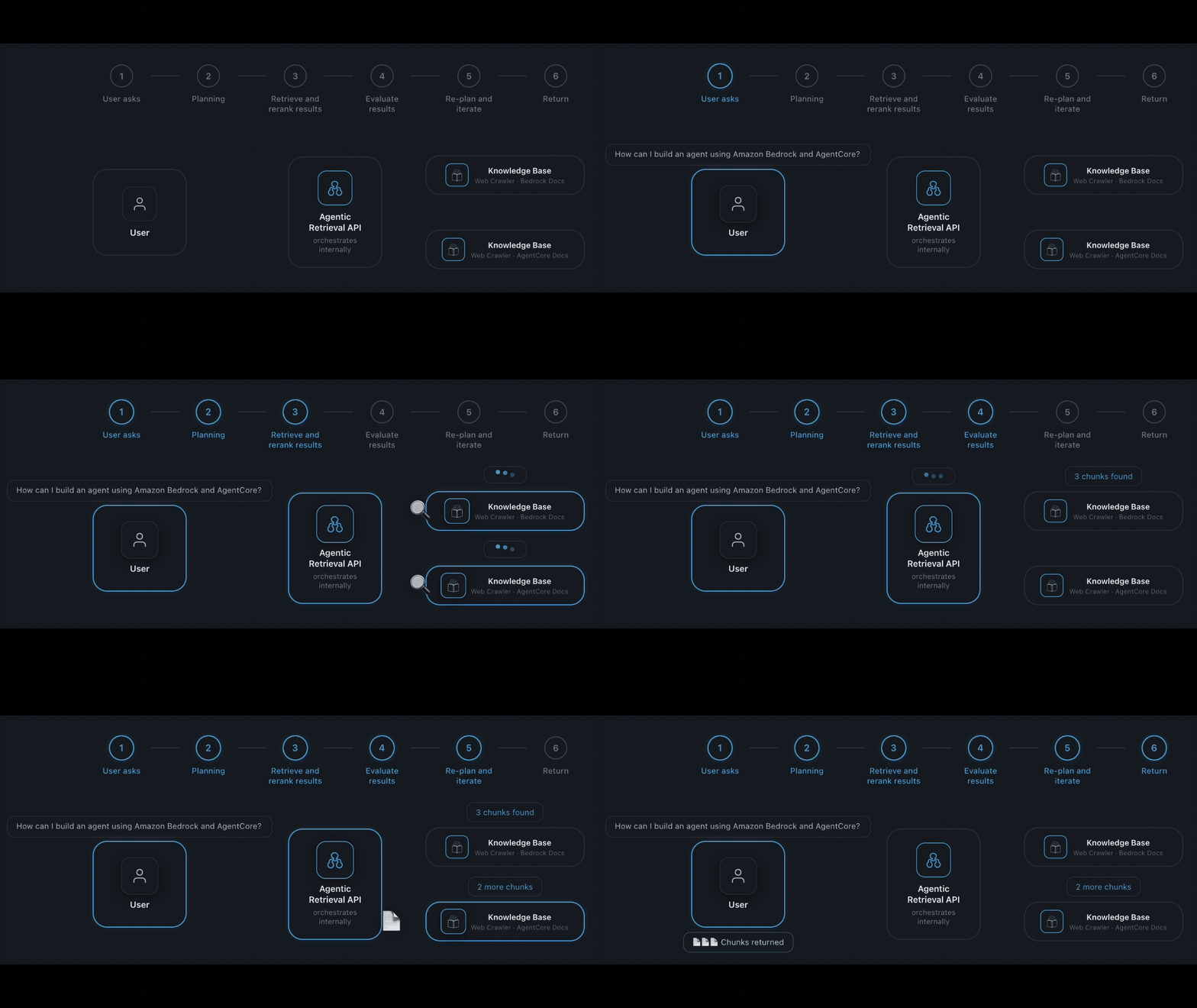
<p>Agentic retrieval plans and iterates over retrieval and can generate a response in the same call. This post focuses on why classic retrieval falls short on multi-part questions, how the AgenticRetrieveStream API works (including request construction and trace parsing), and when to choose it over the standard Retrieve API.</p>
<h2 id="why-single-shot-retrieval-falls-short">Why single-shot retrieval falls short</h2>
<p>A worked example makes the gap concrete. Suppose you have ingested 25 years of Amazon shareholder letters into a Managed Knowledge Base. Your first question is direct:</p>
<p><em>“What is the most important message in the documents?”</em></p>
<p>The standard <a href="https://docs.aws.amazon.com/bedrock/latest/APIReference/API_agent-runtime_Retrieve.html" target="_blank" rel="noopener">Retrieve API</a> returns five chunks by hybrid score. In our test corpus, the top result is high-scoring but low-value: it covers the Amazon logo color scheme. The following chunks cover hiring, builders, and differentiation. The retriever did its job and ranked by similarity to the query embedding. But “<em>most important message</em>” is vague, and the scorer has no signal for what matters.</p>
<p>Now escalate to a realistic question:</p>
<p><em>“Compare how Amazon talked about hiring, long-term investment, and customer obsession in 2020 vs 2023. Where did emphasis shift?”</em></p>
<p>Single-shot retrieval must now serve three intents across two time periods with one query vector. You get one of two outcomes: a scatter of loosely related chunks, or a tight cluster dominated by the strongest signal. Neither is what a human analyst would do.</p>
<h3 id="what-a-human-analyst-would-do">What a human analyst would do</h3>
<p>A human would decompose the question. They would search hiring in 2020, then hiring in 2023, then investment philosophy in each year. They would read the results, notice gaps, refine the search, and run it again. With enough evidence in hand, they would synthesize.</p>
<p>Agentic retrieval automates this workflow as an API.</p>
<h3 id="gaps-left-by-single-shot-retrieval">Gaps left by single-shot retrieval</h3>
<ul>
<li><strong>Multi-part questions:</strong> A single embedding may not represent a multi-intent query well, so top-k results tend to blend intents together.</li>
<li><strong>Comparative reasoning:</strong> “Compare A and B across dimension X” requires targeted retrieval per item, not one blended search.</li>
<li><strong>Cross-source questions:</strong> When evidence spans multiple knowledge bases, static routing rules are brittle and might not adapt well per query.</li>
<li><strong>Sufficiency:</strong> Classic retrieval doesn’t judge “enough.” It returns k chunks regardless.</li>
<li><strong>Exploration:</strong> Some questions need follow-up searches based on what the first results reveal. Single-shot retrieval can’t iterate.</li>
</ul>
<p>Teams have addressed this gap with custom agent frameworks built on the Retrieve API. They prompt a model to plan and call Retrieve API in a loop, manage sub-queries, deduplicate, and decide when to stop. It works, but it beco
分享
阅读原文 ↗