Daily Tech Briefing
AI 科技速览
每天 5 分钟内学习 AI。获取最新的人工智能新闻,理解其重要性,并学习如何将其应用于您的工作。
AWS ML Blog · 2026/7/27 16:11:32
Beyond RAG: Task-aware knowledge compression for enterprise AI on AWS
AI 中文解读
AWS推出了一项创新技术“任务感知知识压缩”,让AI在处理成百上千份文件时,能像专业分析师一样精准抓取关键信息,而不再只是零散地拼凑相似段落。
简单来说,以前用AI查资料就像在图书馆里随机翻书,只能找到一两句看起来相关的话,但遇到需要串联十多份报表、上百份合同才能回答的复杂问题时,AI就彻底“罢工”了。而新方法像给每份文档做了“重点摘要笔记”——针对不同任务(比如财务分析或合规审查)只保留最相关的内容,AI直接读笔记就能回答问题,还能轻松跨文档建立联系。比如投资公司想评估收购风险,AI可以同时从财务报表、供应商合同、环保报告和法律案件中提炼出关联信息,给出整体判断。
这项技术主要影响企业级应用,尤其金融、法律、审计等需要处理海量文档的行业。未来,你向AI咨询投资建议或研究法律条文时,它能给出更全面、更准确的答案,而不是碎片化的片段。开发者也更容易在AWS上部署开源实现,让复杂知识库的问答效率大幅提升。
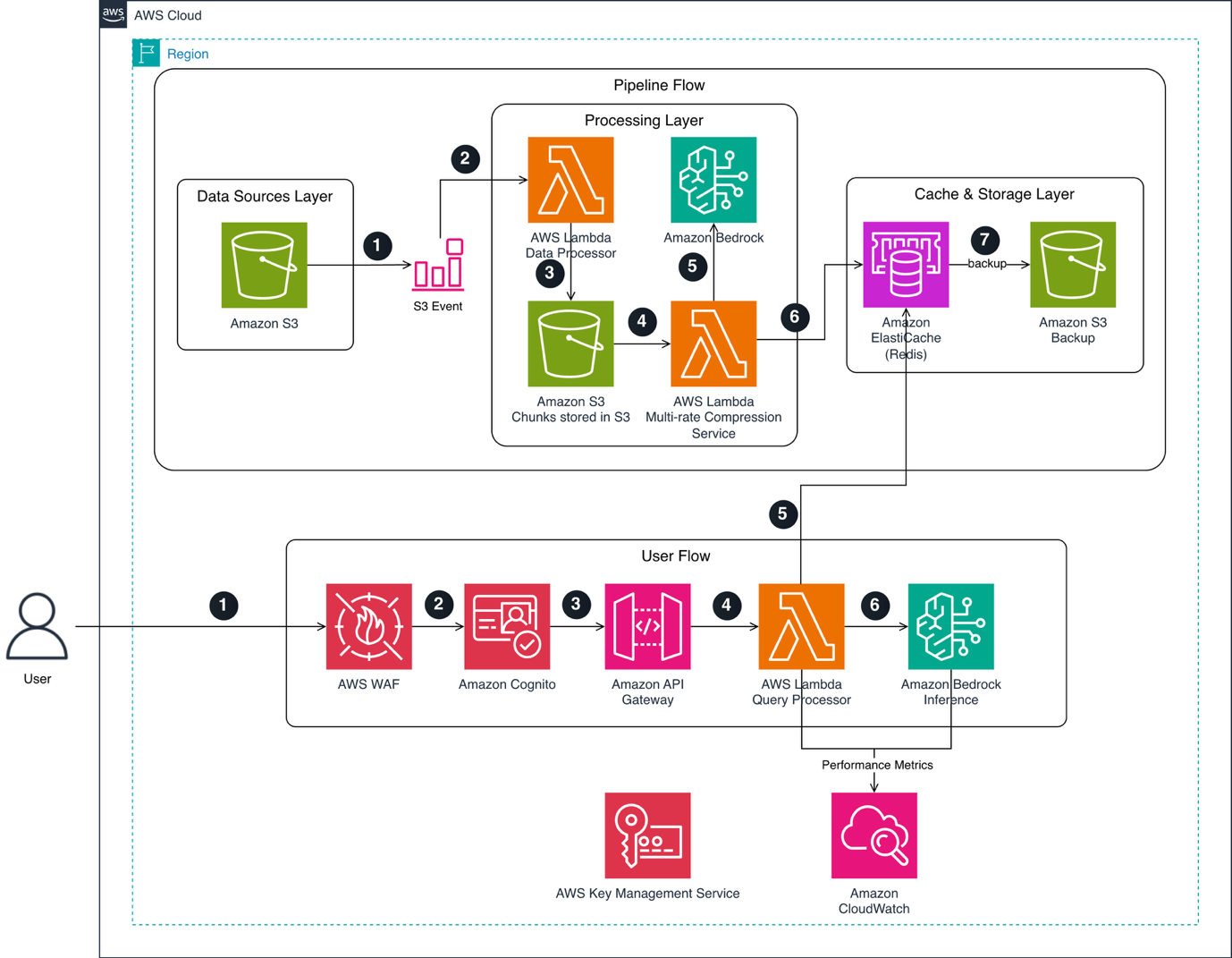
<p>If you’re using <a href="https://docs.aws.amazon.com/sagemaker/latest/dg/jumpstart-foundation-models-customize-rag.html" target="_blank" rel="noopener">Retrieval-Augmented Generation</a> (RAG) for complex analytical tasks that span hundreds of documents, such as financial due diligence or regulatory compliance reviews, you’ve likely hit its ceiling. Similarity search surfaces relevant fragments but often misses cross-document connections. This post shows you how to address that gap using task-aware knowledge compression (TAKC), a technique that pre-compresses entire knowledge bases into task-specific representations deployed on AWS. You can deploy a complete open-source implementation in your own account.</p>
<h2>Task-aware knowledge compression</h2>
<p>Consider a private equity firm evaluating a $500 million acquisition of a manufacturing company. The due diligence team must analyze financial statements spanning 12 subsidiaries and 5 years. They also face 200+ supplier contracts, environmental compliance reports from 8 facilities, and 50+ legal cases. When an analyst asks about consolidated financial risks given current supplier terms and pending litigation, RAG’s similarity search cannot surface that response. Hundreds of documents hold the relevant information, and the connections between them share no lexical similarity.</p>
<p>TAKC addresses this type of problem by using an LLM to produce shorter, task-focused summaries of documents, with different summaries for different tasks.</p>
<p>Different tasks require different information from the same document. An annual report compressed for financial analysis needs revenue figures, margins, and cash flow data. The same report compressed for a compliance review needs regulatory citations and violation histories. Generic summarization attempts to cover everything, which dilutes the information density for any specific use case. TAKC compresses documents through the lens of a specific task, keeping what matters and discarding the rest. The Ingestion pipeline section shows how the compression prompt specifies exactly what information to preserve. For production deployments, store task-type prompts in a versioned configuration (such as AWS Systems Manager Parameter Store or a dedicated Amazon Simple Storage Service (Amazon S3) prefix) so that prompt changes are auditable and recompression can be triggered when prompts are updated.</p>
<p>The system compresses documents offline, once per document per task type. At query time, the system retrieves a pre-compressed representation rather than the original document. The system then answers questions using the compressed version instead of the full document. If the compressed representation lacks sufficient detail, the query complexity analyzer routes the question to a lower compression tier that retains more context.</p>
<p>TAKC provides access to the <em>entire</em> knowledge base in compressed form, not just the top-k chunks that a similarity search returns. The system preserves connections between documents because the compression sees documents together. It also produces different compressed outputs for different tasks from the same source material. The financial compression of a 10-K filing looks nothing like the legal risk compression of that same filing. The compression reduces token count by 8x to 64x while targeting task-relevant information for retention.</p>
<h2>Multi-rate compression</h2>
<p>Different queries require different levels of fidelity. A question such as “What was Q3 revenue?” needs far less context than a request to analyze relationships between supplier payment terms and quarterly cash flow across subsidiaries.</p>
<p>TAKC addresses this by maintaining four compression tiers for each task type. At the lightest compression (8x), the system retains approximately 87.5% less context. It preserves enough detail for multi-step reasoning and cross-document synthesis. At the medium tier (16x), context reduct
分享
阅读原文 ↗