Daily Tech Briefing
AI 科技速览
每天 5 分钟内学习 AI。获取最新的人工智能新闻,理解其重要性,并学习如何将其应用于您的工作。
Nature Machine Intelligence · 2026/7/21 00:00:00
Neural sampling from cognitive maps enables goal-directed imagination and planning
AI 中文解读
科学家发现,人脑仅用20瓦的功率就能做到的事,AI却要消耗成千上万倍的能量——那就是快速规划、想象和解决问题。这项发表在《自然·机器智能》上的研究,揭示了一个关键机制:大脑内部有一套“认知地图”,通过神经采样就像在头脑中快速预演各种可能,从而找到最优解。这很像你闭着眼想象从家到超市的几条路线,然后选出最快的那条,但大脑用了更聪明的算法。研究团队正尝试把这种机制移植到AI中,让机器也能像人一样“举一反三”:遇到新问题时,不靠海量数据训练,而是即时在内部“地图”上模拟推演。这意味着未来的AI可能不再需要庞大的算力和数据中心,而是像人一样低功耗、自适应地学习。例如,家庭机器人能瞬间适应你重新布置的客厅,自动驾驶汽车在陌生街道也能灵活规划路径。这项突破有望让AI从“笨重的算力巨兽”进化成“轻巧的思考者”,走进每个人的日常生活。
Download PDF
Article
Open access
Published: 21 July 2026
Neural sampling from cognitive maps enables goal-directed imagination and planning
Hui Lin1,2 na1, Yukun Yang
ORCID: orcid.org/0000-0001-6016-04342 na1, Rong Zhao
ORCID: orcid.org/0000-0002-2320-03261, Giovanni Pezzulo
ORCID: orcid.org/0000-0001-6813-82823 & …Wolfgang Maass
ORCID: orcid.org/0000-0002-1178-087X2 Show authors
Nature Machine Intelligence
volume 8, pages 1045–1065 (2026) Cite this article
Save article
View saved research
5022 Accesses
1 Altmetric
Metrics details
Subjects
Computational scienceLearning algorithmsNetwork models
A preprint version of the article is available at bioRxiv.
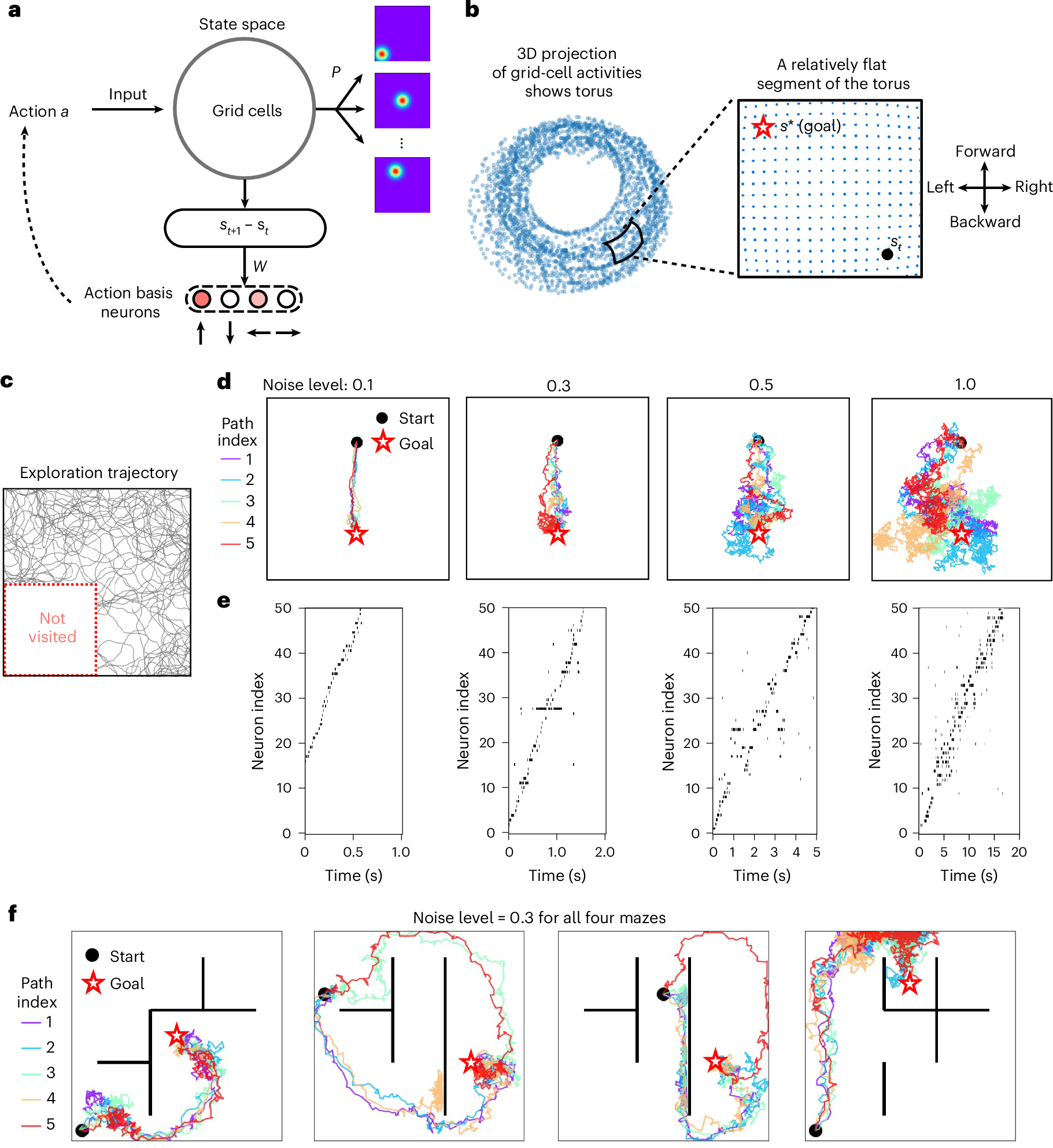
AbstractArtificial intelligence systems are becoming more intelligent, but at a very high cost in terms of energy consumption and training requirements. By contrast, our brains only require 20 W of energy, they learn online and they can instantly adjust to changing contingencies. This begs the question what data structures, algorithms and learning methods enable brains to achieve that, and whether these can be ported into artificial devices. We are addressing this question for a core feature of intelligence: the capacity to plan and solve problems, including new problems that involve states that were never encountered before. Here we examine three tools that brains are likely to use for achieving that: cognitive maps, stochastic computing and compositional coding. We integrate these tools into a transparent neural network model, and demonstrate its power for flexible planning and problem-solving. Importantly, this approach is suitable for implementation by in-memory computing and other energy-efficient neuromorphic hardware. In particular, it only requires self-supervised local synaptic plasticity that is suited for on-chip learning. Hence, a core feature of brain intelligence—the capacity to generate solutions to problems that were never encountered before—does not require deep neural networks or large language models, and can be implemented in energy-efficient edge devices.
Similar content being vie
分享
阅读原文 ↗