Daily Tech Briefing
AI 科技速览
每天 5 分钟内学习 AI。获取最新的人工智能新闻,理解其重要性,并学习如何将其应用于您的工作。
HackerNoon AI · 2026/7/22 06:43:27
How I Built an AI Agent That Makes Videos While I Sleep
AI 中文解读
一位技术创业者成功打造了一个能在他睡觉时自动生成视频的AI代理,成本仅1.91美元就能产出五条成品,全程无需人工干预。这个名为Safebird的自动化系统就像一个尽职的虚拟剪辑师,深夜自动构思选题、写脚本、生成德语配音和背景音乐,最后渲染出30秒竖屏视频并上传到YouTube。它的设计精髓是“判断在前,花钱在后”——先用廉价的大语言模型(每次约0.23美元)完成创意决策,通过审核门控后才启动语音合成、音乐生成和渲染等耗资环节,避免了预算浪费。此前失败的版本曾试图让AI直接编写视频画面代码,结果布局不可靠;而新方案将创作拆解为七个步骤,其中只有三步依赖AI创意,其余步骤都是稳定执行的确定性代码。这套技术对普通人而言,意味着内容创作门槛被大幅拉低:小企业主或自媒体人不需要掌握剪辑技能,就能以几分钱的成本批量生产营销视频;自媒体运营者甚至可以设置好规则,让AI自动跟踪品牌调性并定期发布,真正实现“睡觉也在产出内容”。未来,类似AI代理可能让更多重复性创意工作实现自动化,普通人只需把控方向和风格,执行细节全部交给机器。
Discover AnythingSignupWrite New StoryHow I Built an AI Agent That Makes Videos While I SleepbyMrclbyMrcl|@mrclhnzCEO at https://www.safebird.aiManagement consultant by day, builder by night. Shipping daily. chief human at ➡️ http://safebird.aiSubscribeJuly 22nd, 2026TLDR Your browser does not support the audio element.Speed1xVoiceDr. One Ms. Hacker byMrcl@mrclhnzbyMrcl|@mrclhnzCEO at https://www.safebird.aiManagement consultant by day, builder by night. Shipping daily. chief human at ➡️ http://safebird.aiSubscribeStory's CredibilitybyMrcl|@mrclhnzCEO at https://www.safebird.aiManagement consultant by day, builder by night. Shipping daily. chief human at ➡️ http://safebird.aiSubscribeStory's Credibility Video example is at the end.Somewhere in a Railway datacenter in the Netherlands, a small worker process wakes up on a cron schedule. Over the next 2 minutes and 20 seconds it invents five video ideas, argues with itself about which one is best, writes a script, checks the script against my brand rules, generates a German voiceover and a music bed, renders a 30-second vertical video, and uploads it to YouTube.
Then it goes back to sleep for three days.
Total cost for the last days: $1.91. Five videos. My involvement: zero minutes. The videos are for Safebird, the agentic operating system we’re building for insurance brokers.
In my last article I argued that the founders winning right now build systems, not just products. This is what that actually looks like, a running process with a heartbeat. Here's exactly how it's built, including the version that failed, the actual prompts, and the guardrail that kills a run before it can spend my money on an off-brand video.
What the machine actually does
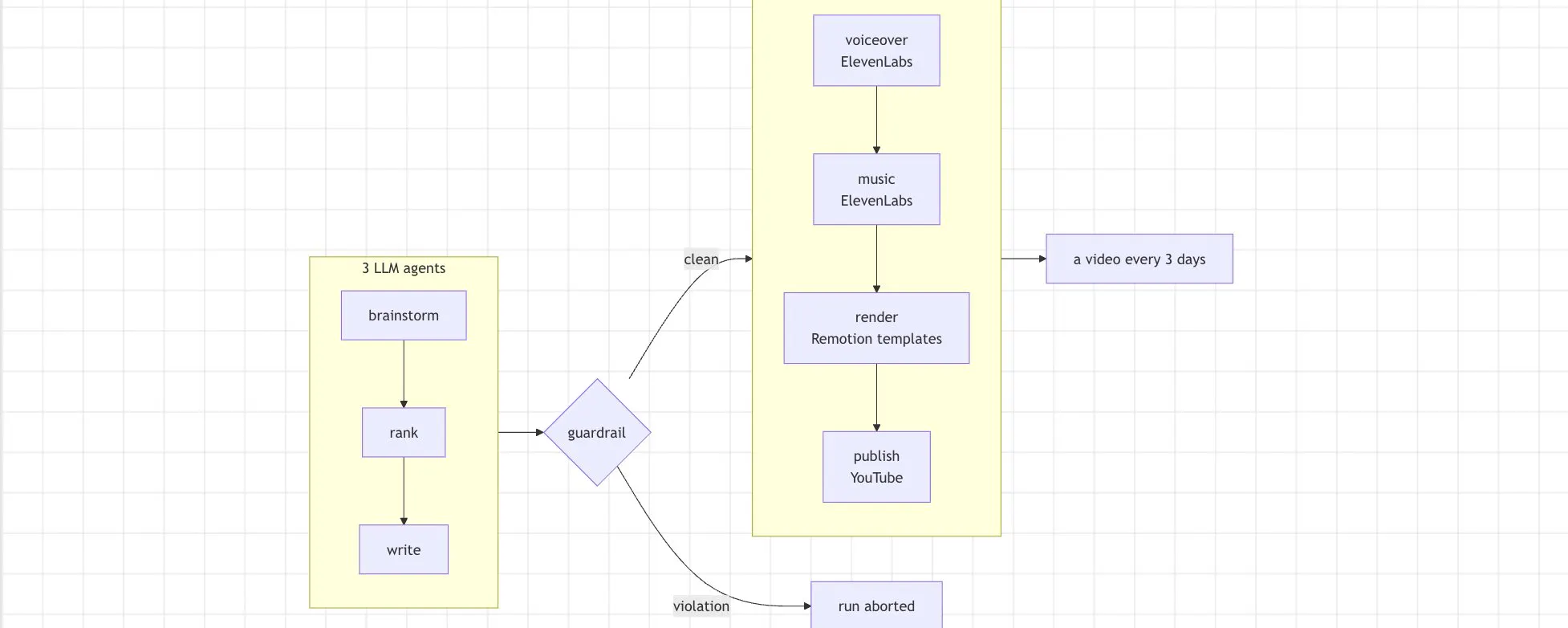
The agent is a pipeline of seven steps, and they come in three distinct tiers of predictability. Only three steps use an LLM, GPT-5.6 Terra Pro via OpenRouter, and each of those is a separate, small agent with its own persona, its own prompt, and its own temperature. Two more steps are generative but bounded: ElevenLabs synthesizes the voiceover and the music in single one-shot calls, with no feedback loop. And the remaining steps, the guardrail lint, the Remotion render, the upload, are plain deterministic code: same input, same output, every time.
ImageNotice the shape of it. Three creative steps, then a hard gate, then the production steps. The creative part is cheap (about $0.23 of LLM calls). Everything after the gate costs real money: voice synthesis, music generation, render compute. So the gate sits exactly where the money starts.
That ordering is not an accident. It's the whole design philosophy in one sentence:
Judgment before spend.
The version that failed (and why)
I didn't start here. Version one did what everyone does first: I let the LLM create the visuals.
The LLM authored raw Remotion TSX code for every scene, including layouts, animations, positioning, all of it. Then, because LLM-generated layouts are unreliable, I added a second LLM pass to look at rendered frames and grade them, a multimodal image-QA loop that regenerated scenes until they passed.
It technically worked. It was also a disaster:
~€6 per video: per-scene code generation plus the image-QA loop burned tokens like a furnace.
Contrast issues, text overflow, visual artifacts: a model that writes brilliant German copy turns out to be a mediocre layout engine.
Hard API failures: GPT-5.6 Terra Pro is a reasoning model, and reasoning tokens count against your max_tokens budget. One-shot generations of ~500 lines of TSX would hit 500 errors. The monolithic "generate everything in one call" approach didn't just look bad, it died at the API level.
The fix came from accepting a simple truth about what these models are actually good at:
LLMs are excellent at picking and filling. They're bad at pixel-perfect creation.
So I took the pixels away from the model. I hand-designed a library of ten parameterized scene templates: kinetic headlines, quote cards, chat
分享
阅读原文 ↗