Daily Tech Briefing
AI 科技速览
每天 5 分钟内学习 AI。获取最新的人工智能新闻,理解其重要性,并学习如何将其应用于您的工作。
Nature Machine Intelligence · 2026/7/20 00:00:00
A neural network model of free recall learns multiple memory strategies
AI 中文解读
人类记忆的奥妙被AI模型揭开了!《自然·机器智能》的最新研究发现,经过优化的神经网络在模拟自由回忆任务时,竟然自发学会了多种记忆策略,其中最厉害的一种像极了古人用的“记忆宫殿”技巧——通过物品的固定位置顺序来回忆,比依赖时间顺序的传统模型高效得多。
通俗来说,我们平时回忆事情时,往往先想起最近发生的,或者按时间顺序回想。但记忆专家会使用“记忆宫殿”法,把要记的东西“挂”在脑海里熟悉的场景中,按固定位置顺序提取。研究人员让神经网络反复练习回忆列表中的单词,发现网络不满足于简单的“时间顺序”策略,而是自己摸索出了一套类似“记忆宫殿”的策略:给每个词编一个位置序号,按序号顺序回想,就像按图索骥一样稳定高效。而且,只有当网络被要求必须记住所有内容、不能只依赖“最近才看到”的优势时,这种顶级策略才会出现。
这项发现对普通人有什么启发?它告诉我们,想要提升记忆力,不要只靠“刚看过所以记得住”的临时优势,而要学会给每个信息贴上一个固定的“位置标签”。比如背单词时,想象它们在卧室里的不同角落,回忆时按顺序“走一遍”,就能达到专家的水平。未来,教育软件和记忆力训练工具也可以借鉴这个算法,帮我们更聪明地记住想记住的东西。
Article
Published: 20 July 2026
A neural network model of free recall learns multiple memory strategies
Moufan Li
ORCID: orcid.org/0009-0004-6611-91241, Kristopher T. Jensen2, Qiong Zhang
ORCID: orcid.org/0000-0001-9062-95713,4, Qihong Lu5 & …Marcelo G. Mattar
ORCID: orcid.org/0000-0003-3303-24901,6,7 Show authors
Nature Machine Intelligence
(2026) Cite this article
Save article
View saved research
Subjects
Human behaviourLong-term memoryNetwork models
A preprint version of the article is available at bioRxiv.
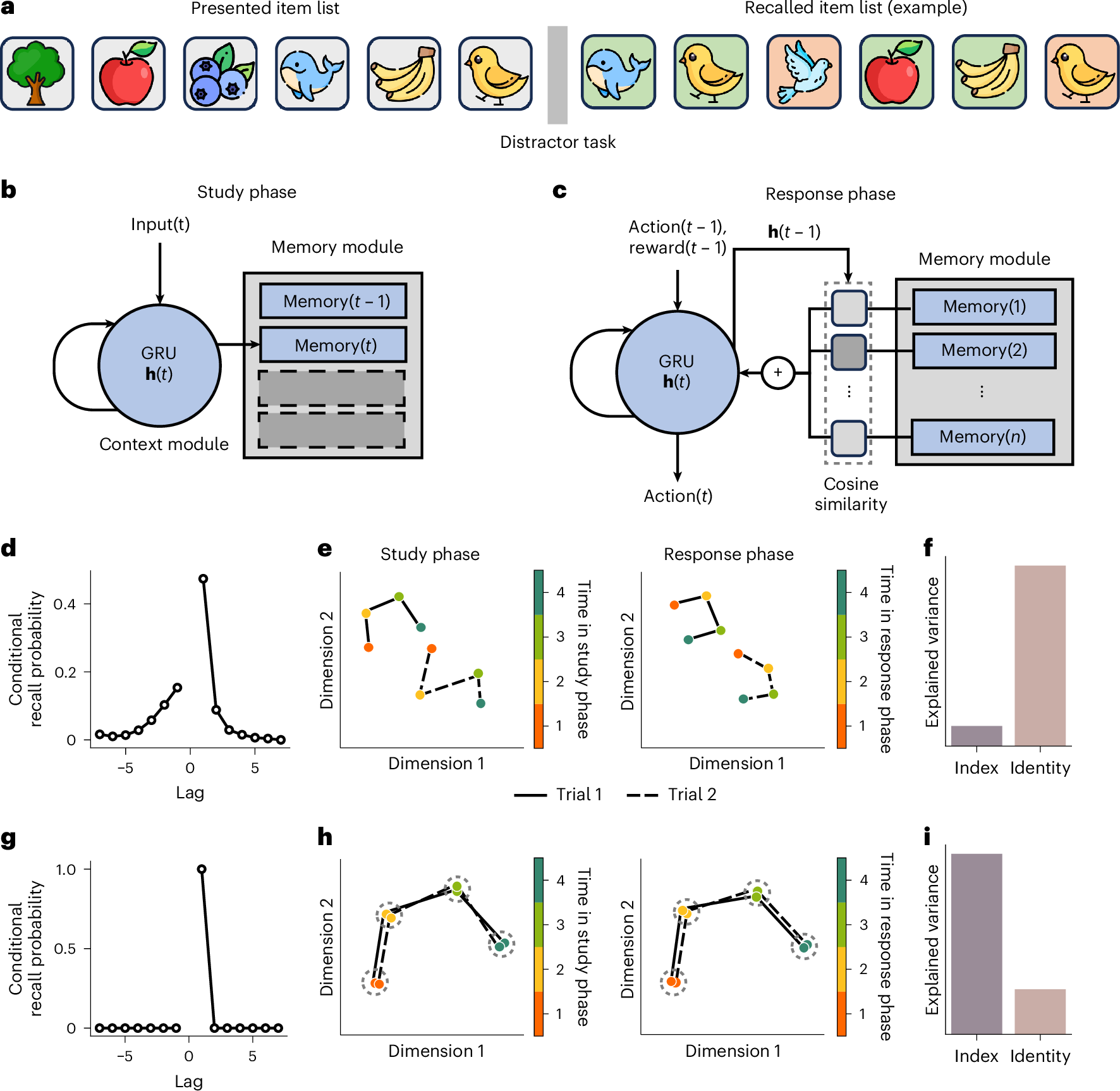
AbstractHumans exhibit structured patterns of memory recall, including a tendency to recall more recent information and to recall events in the same order they were experienced. Classic computational models explain these patterns by positing that memories incorporate the ongoing ‘temporal context’, formed by smoothly integrating the stimulus history. However, it is unclear whether a single mechanism can account for the full repertoire of human memory strategies, and if this posited mechanism is optimal for recall performance. For example, human memory experts widely apply the ‘memory palace’ strategy, which is empirically better but not captured by temporal context models. Here we show that neural networks optimized for free recall develop diverse retrieval strategies, with only some of them resembling temporal context models. The best-performing models discovered a stimulus-invariant index code that emphasizes the studied position of each list item, instead of its temporal context. This creates a stable scaffold for forward recall akin to the memory palace technique. This index code was more likely to emerge when networks were (1) encouraged to recall all studied items rather than prioritizing only the next few items, and (2) prevented from relying on recency. Our findings demonstrate that human-like recall patterns can arise from multiple distinct computational mechanisms, and that sequential retrieval using item index is an optimal strategy that explains expert-level recall performance.
Access through your institution
Buy or subscribe
This is a preview of subscription content, access via your institution
Access options
Access through your institution
/* style specs start */
/* style specs end */
Access Nature and 54 other Nature
分享
阅读原文 ↗