Daily Tech Briefing
AI 科技速览
每天 5 分钟内学习 AI。获取最新的人工智能新闻,理解其重要性,并学习如何将其应用于您的工作。
AWS ML Blog · 2026/7/21 16:23:12
Exploring self-distilled reasoning for supervised fine-tuning with Amazon Nova
AI 中文解读
亚马逊云科技推出了一种创新的AI训练方法——自蒸馏推理(SDR),让模型在微调时“自己教自己”思考,既提升了在编程、数学等难题上的表现,又避免了学到新东西时忘掉旧知识的困扰。
以往,训练AI解决复杂问题需要人工准备大量“思考过程”数据,既费钱又耗时。如果不加思考过程直接训练,模型又会失去推理能力。SDR的巧妙之处在于,它让基础模型自己生成思考过程,再用这些思考去训练自己——就像学生先自己写解题步骤,再根据步骤巩固知识点。这样,模型既能掌握新任务,又不会“学了这个忘了那个”,保持了整体能力。
这项技术将直接让使用亚马逊AI服务的应用变得更聪明、更稳定。比如,你用AI助手解数学题、写代码或者处理专业文档时,它的回答会更准确可靠,而且不会因为更新后突然变“笨”。对普通用户来说,这意味着未来AI产品在完成复杂任务时更值得信赖,同时还能保持一贯的智能水平,不用担心“更新一次退步一次”的尴尬。
<p>When you fine-tune a model using Supervised Fine-Tuning (SFT), creating high-quality chain-of-thought (CoT) reasoning traces for your training data is often impractical and can be prohibitively expensive. As a result, you might choose to skip reasoning during SFT and train with only inputs and outputs. However, reasoning is a key capability of the <a href="https://aws.amazon.com/nova/models/" target="_blank" rel="noopener">Amazon Nova 2</a> family of models, and it’s been shown to significantly enhance prediction performance in Nova and other frontier models, often with performance gains on hard problems like coding and math. With Amazon Nova 2 customization, you can use the power of thinking models on your specific domains through techniques such as SFT and Reinforcement Fine-Tuning (RFT). For SFT, a key requirement to unlock these gains is the availability of golden CoT traces in the SFT dataset, that is, thinking traces from a strong teacher model that have been further validated and cleaned.</p>
<p>In this post, we explore an idea for generating thinking tokens for datasets that lack reasoning traces in SFT customization. We first examine the reasoning suppression problem, then introduce Self-Distilled Reasoning (SDR), validate it across three benchmarks, and provide practical recommendations. SDR re-uses the chain of thought from the base Amazon Nova 2 Lite model as a stand-in for non-reasoning datasets. Through our experiments we make a few observations on the impact of introducing SDR, from improving target performance to mitigating <a href="https://arxiv.org/abs/2501.17161" target="_blank" rel="noopener">catastrophic forgetting</a>. This is in line with a growing body of work that is discovering the importance of distilling information from a model into itself during training, otherwise known as <a href="https://arxiv.org/html/2601.19897v1" target="_blank" rel="noopener">self-distillation</a>.</p>
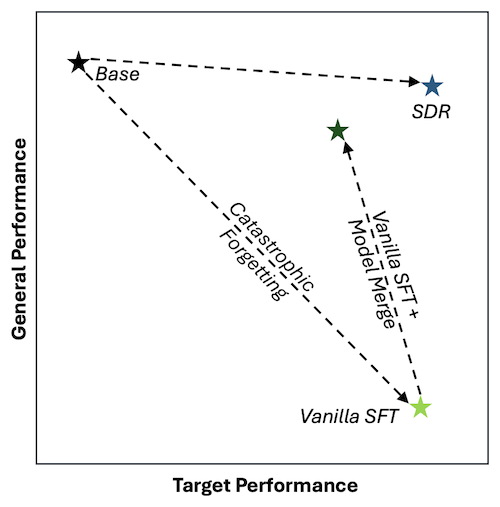
<p>The following figure illustrates how SDR compares with vanilla SFT and model merging across target performance and math retention. Model merging is a straightforward approach to retain previously acquired skills, that takes an SFT checkpoint and merges it back to the base model (before SFT). However, merging often comes at the expense of forgoing gains obtained on the SFT checkpoint because of catastrophic forgetting which manifests as a trade-off between target and general performance. SDR on the other hand mitigates this issue with similar or better target performance as pure SFT (with no merging) while retaining most of general performance.</p>
<p><img class="size-full wp-image-135745 aligncenter" src="https://d2908q01vomqb2.cloudfront.net/f1f836cb4ea6efb2a0b1b99f41ad8b103eff4b59/2026/07/21/ML-20897-1-1-1.png" alt="Chart comparing SDR, vanilla SFT, and model merging across target performance and math retention" width="500" height="507"></p>
<p>Because of catastrophic forgetting, we observe that SFT on a dataset can lead to previous knowledge being completely lost. For instance, we find that vanilla SFT leads to Math performance dropping from 70 percent (base) to 6 percent on average (Table 2). With SDR, we’re able to almost entirely recover it back. Self-distilled reasoning allows us to retain the base model’s capabilities without compromising on target performance, and in many cases it improves target performance as well. Model merging is a common solution to mitigate catastrophic forgetting, but SDR achieves this retention more effectively.</p>
<p>SDR provides in-training regularization by augmenting the dataset with the model’s own reasoning traces. It doesn’t require a separate teacher model or post-hoc interpolation. This approach requires no human annotation, is applicable to existing SFT datasets regardless of domain, and is more effective than model merging at preserving both target and general performance.</p>
<p>Compared with model merging, self-distillation yields nearly identical math performance (7
分享
阅读原文 ↗